Anchoring Your Life in What Matters Most
How do you determine what matters most in your life?
It’s a question that’s easy to overlook - and one that may reveal more about us than we care to admit.
We all develop a way of making sense of things, shaped by our experiences, the values we embrace, and the beliefs that guide us. But if my experience is any indication, there are times in life when we aren’t thinking about what truly matters most. We’re thinking about what’s wrong or missing, what we want or fear, or what we feel pressured to become.
We think, “If only I could fix this… achieve that… escape this… or buy that…” then life would finally feel as it should.
So we pursue whatever we believe will meet those needs or fulfill those expectations. And in that pursuit, we may begin to “drift” - a subtle, gradual movement away from who we believe ourselves to be, often without realizing it.
Over time, the pursuit becomes a priority, the priority becomes a pattern, and eventually that pattern of “fixing, achieving, escaping, or buying” becomes what we trust to make life work - a trust that often forms before we notice it.
And that trust can latch onto almost anything - especially whatever helps us feel better, comforts us, or uplifts us. Those desires and beliefs start influencing our actions - and our actions reveal what actually matters most. It’s not that we abandon our core values or identity; it’s that we begin unconsciously trusting what is unreliable.
And I found that whatever we trust most - whatever our actions reveal matters most - becomes our anchor, our true north. Our thoughts, feelings, and responses become tethered to it, shaping how we interpret life and make decisions about what truly matters.
Some may believe they aren’t anchored to anything at all. That may sound or feel like drifting. But drifting isn’t the absence of an anchor - it’s the absence of clarity about who we are and what is already anchoring us.
Which means the questions I think we should be asking are these -
- What am I truly anchored to?
- How reliable is it?
- And ultimately, what - or who - is my true north?
What Am I Truly Anchored To?
If we pause and take an honest look at our lives, we might discover that our anchors are the very things our culture elevates - power, position, possessions, performance, and popularity. We may not consciously choose them, but there may be seasons where we fixate on them, strive for them and unknowingly depend on them.
Some people anchor to enduring values or faith early on. But even then, the pull of other anchors, such as success, image, or comfort, can quietly compete beneath the surface.
Another anchor can be expectation - our own or someone else’s - a version of ourselves we feel responsible to achieve and maintain. For others, it’s the everyday influences of modern life - online opinions, the validation of likes or follows, or the pressure to keep up.
And for those who excel easily or are uniquely gifted, the drift can likely be even harder to detect. Abundance, talent, and recognition can create the illusion that everything is aligned - even when it isn’t.
We may even discover we have several anchors, because different anchors can meet different needs –
- Success for significance
- Relationships for security
- Appearance for acceptance
- Work for identity
- Control for predictability
I’ve learned that these anchors can create an inner tension, especially when the ways they pull us don’t align with our values, identity, or the person we’re striving to become. And they tend to reveal themselves when life presses us - when we’re stressed, uncertain, searching for reassurance, afraid of losing something, or feeling pressure to prove something.
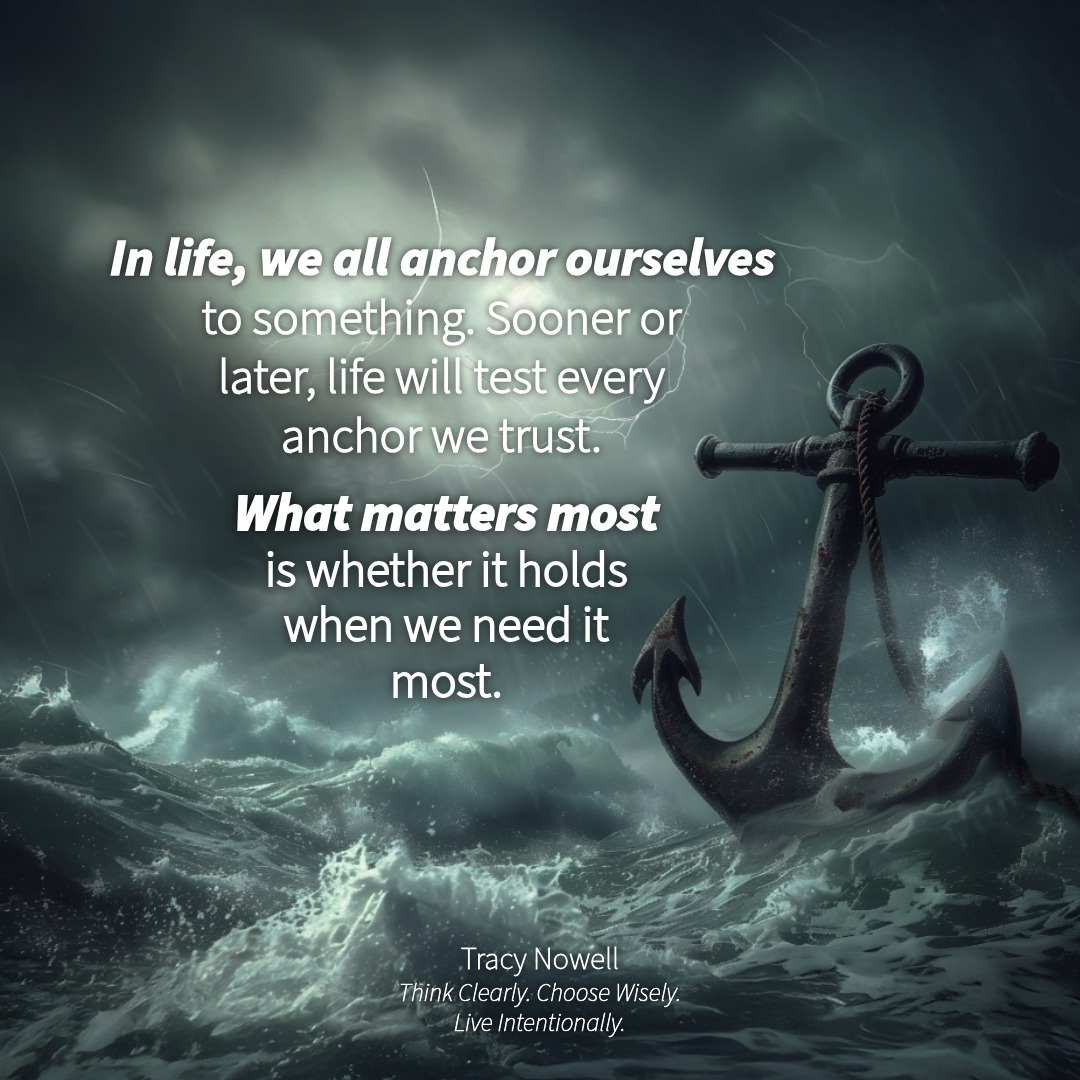
In life, I’ve come to believe we all anchor ourselves to something. And sooner or later, life will test every anchor we trust. What matters most is whether it holds when we need it most.
How Reliable Is My Anchor?
The highest compliment I can give anyone - or anything - is my trust. And because I believe trust must be earned, my measure of trustworthiness is reliability. Through trial and error, I’ve learned the difference between what proves unreliable and what doesn’t.
But here’s the real problem - we tend to assume our anchor will hold because it held once before - long enough to give us what we wanted at the time. But reliability isn’t measured by how well something works in ideal conditions.
A reliable anchor must hold under pressure, hold in uncertainty, and hold when life doesn’t cooperate with our plans or expectations.
And as I’ve written before in a prior article, power can fade, positions shift, possessions disappear, performance can falter, and popularity can decline.
Even the people we love and depend on can fail us -
- Parents can wound us.
- Spouses may leave us.
- Partners can betray us.
- Friends can vanish when we need them most.
And the things we chase for stability - approval, control, comfort, and online validation - often function less like anchors and more like temporary props. They may make us feel better in the moment, but when life gets real, we might lose them a bit too easily.
Reliability isn’t about what we hope we can trust on our best days. Reliability is about what we know we can trust when everything around us feels like it’s cratering.
What Happens When My Anchor Doesn’t Hold?
When the anchor we’ve relied on doesn’t hold, the real issue is whether we have the awareness to notice it. We may feel the drift - the instability inside - yet not recognize that it’s signaling something important.
And once we finally notice the signal, we face a choice.
We can ignore it and fall back into the familiar cycle of trying to fix, achieve, escape, or buy our way back to stability. Or we can step back and ask -
- Am I clinging to something that can’t hold?
- Am I repeating patterns that no longer serve me?
- Am I mistaking action for progress - and following a faulty compass for direction?
Awareness, when we pay attention, can interrupt the drift. It opens the door to finding the truth we’ve overlooked, facing reality and recognizing when we need a stronger anchor and a wiser course.
And this becomes a defining turning point -
Do I keep trusting what keeps failing me - or do I seek an anchor strong enough to hold me firm, and steady enough to guide me as my true north?
Final Thoughts
As I look back over my life, one truth has become clear -
We all need an anchor strong enough to hold when the storms of life unravel our tether to the things we once trusted.
Careers change. Relationships shift. Life turns without warning. Storms can take much from us - but they cannot take who we are at our core, unless we allow them to.
And that core matters.
It’s our core values, fundamental beliefs, authentic strengths, and guiding principles that give structure to who we are. They are what remain when everything else is stripped away - including the things we once mistook for identity.
They endure because they’re the inner commitments we choose, cultivate, and align ourselves with over time - the things life can shake but not take unless we surrender them.
And when the storms rage, they reveal whether our lives are anchored to something solid… or something fragile.
I learned this the hard way because I lived it.
In my twenties, I anchored myself to performance, achievement, and work ethic. And for a long time, those anchors “worked” - or at least appeared to. They helped me succeed, endure and push forward. But when real storms hit - the kind that expose what’s weak, temporary, or unsustainable - those anchors weren’t enough to hold me steady.
That season forced me to ask questions I had never thought to ask - questions that revealed what was insufficient and pointed me toward a stronger anchor, one rooted not in achievement or control, but in truth.
Which brings me back to a question I eventually had to ask decades later during another major storm - one that upended almost every facet of my life at once -
What could I not afford to lose… without losing myself?
For me, the answer, in both seasons, was my trust in God and His reliability.
Why?
Because God is the source of my core values, fundamental beliefs, authentic strengths, and guiding principles - the core of my identity. He is the one constant that remains when everything else is stripped away.
He became my true north in that first season, and He has remained my true north ever since. His character, His promises, His faithfulness, and His instruction steadied who I was when everything else shifted.
My trust in Him - and my relationship with Him - was, and still is, what matters most. It’s what I cannot afford to lose without losing myself.
And as we enter the Christmas season filled with gifts, gatherings, and traditions, it’s worth remembering that Christmas is, at its core, the story of the One true anchor entering the world - the One true north that does not shift with circumstance or time.
So let me leave you with the question that brings this entire article into focus -
Are you anchoring your life in what truly matters most - and will your anchor hold when it matters most?