Facing Change Head-On - It's a Choice You Must Make
At times, it seems inevitable - just when we finally get comfortable with something or someone, or feel life is going great - things change.
We love changes that benefit us, especially when we don't have to change ourselves. Conversely, we tend to resist changes that disrupt our lives, push us out of our comfort zones, or confront us with cold, hard realities we'd rather not face.
The truth is that life doesn't always proceed as orderly or predictably as we might expect, and neither does our growth and maturity.
Some changes occur naturally over time, while others result from decisions we make or circumstances beyond our control. And even when we believe we're moving in the right direction, unexpected developments can alter our course or force us to reconsider where we're heading.
In our professional lives, changes in leadership, career opportunities, technology, or economic conditions can disrupt familiar routines and expectations.
In our personal lives, changing relationships, family responsibilities, financial challenges, health issues, and the realities of maturing or aging can require us to adjust in ways we never expected.
Whether we choose to make changes or they are imposed on us, we must eventually confront the reality of what's happening.
But change isn't always about what's happening around us.
Sometimes, we need to recognize that something within ourselves needs to change - our thinking, attitudes, assumptions, expectations, habits, or behavior.
And sometimes, we must confront changes both in our circumstances and within ourselves at the same time.
Two Opposing Approaches to Change
As I considered this subject, I was reminded of a popular version of the Serenity Prayer, attributed to American theologian Reinhold Niebuhr and widely used in support and recovery groups.
The Serenity Prayer
"Dear God, please grant me the serenity to accept the things I cannot change, the courage to change the things I can, and the wisdom to know the difference."
Although simple in its wording, the Serenity Prayer presents three important challenges in how we approach change.
Accepting the Inevitable
Some circumstances are beyond our control. We cannot change what has already happened, dictate the choices others make, or prevent every unexpected difficulty life brings.
Yet accepting these realities can be hard, particularly when they conflict with our expectations, desires, or beliefs about how things should be.
Acceptance means acknowledging reality for what it is, even when it's uncomfortable, rather than continuing to struggle against what we cannot change.
Courage to Change
Making necessary changes can require making difficult decisions, reconsidering established beliefs, changing unproductive habits, or rethinking how we approach certain situations.
But not every change is driven by necessity or unfavorable circumstances. Sometimes, recognizing a better way to think, act, or approach life is reason enough to change.
After all, how can we expect to learn, grow, mature, or improve if we're unwilling to question our current thinking or how we've always done things?
Even when we recognize the need for change, taking action can involve uncertainty, discomfort, sacrifice, or the possibility of failure.
Courage isn't about acting irrationally or recklessly. It's about confronting challenges and taking informed, intentional action, even when the outcome remains uncertain.
Wisdom to Know the Difference
Knowing what to accept, what to change, and when to stand firm requires wisdom and discernment.
Some circumstances call for patience and acceptance, and others require courage and decisive action. But some changes warrant resistance, especially when they conflict with our core values, guiding principles, and non-negotiables.
Wisdom and discernment enable us to exercise sound judgment.
This requires objectively examining both our circumstances and ourselves - questioning our assumptions, considering the consequences, and honestly assessing what we can and cannot influence or control - without allowing our emotions, expectations, or personal interests to distort our perspective.
The Un-Serenity Prayer
Now consider the opposite approach.
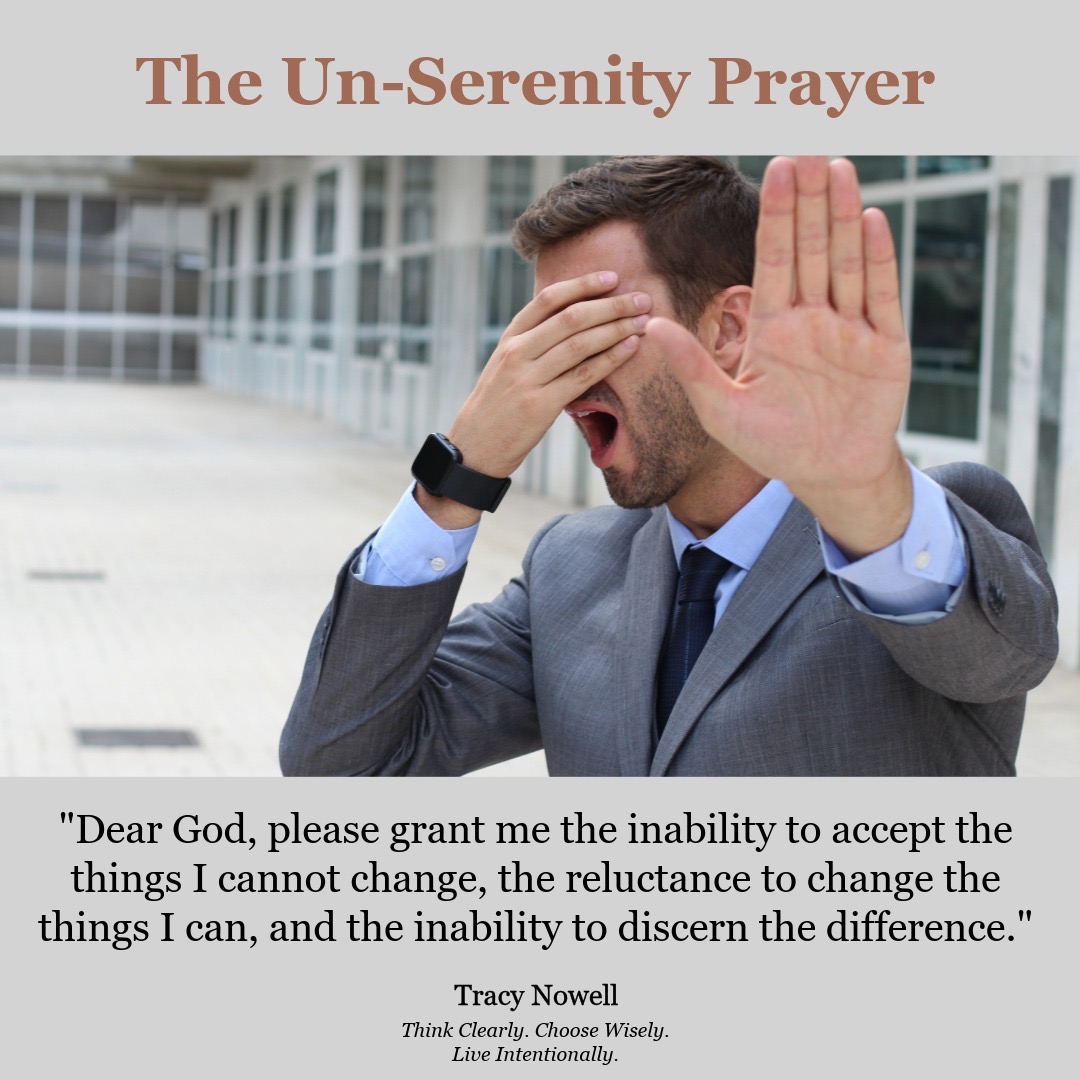
To draw a contrast, I've taken the liberty of revising the Serenity Prayer into what I call the Un-Serenity Prayer.
"Dear God, please grant me the inability to accept the things I cannot change, the reluctance to change the things I can, and an inability to discern the difference."
Although intended as a thought-provoking contrast, this version reveals three tendencies that can become significant obstacles in our lives.
Inability to Accept the Inevitable
When we refuse to accept realities beyond our control, we can become consumed by frustration, resentment, or disappointment. We dwell on what should have happened, how others should have behaved, or why things aren't the way we believe they should be.
Even when the facts are clear, we may cling to our expectations, hoping circumstances will somehow change or return to what they once were.
Rather than accepting reality and considering what comes next, we remain focused on what we wish were different.
And in doing so, our resistance can become a greater obstacle to moving forward than the circumstances themselves.
Reluctance to Change
Sometimes we recognize the truth about our circumstances and understand what needs to change, but we're unwilling to make the necessary adjustments.
We cling to familiar routines, established beliefs, comfortable circumstances, or longstanding habits, even when they no longer serve our best interests. We find reasons to delay, convince ourselves the timing isn't right, or wait for someone or something else to change first.
And when the challenge involves something within ourselves, our reluctance may be even greater.
Acknowledging that internal issues - our thinking, attitudes, expectations, or behavior - may need to change can be more uncomfortable than confronting problems in our external circumstances.
But our reluctance to change can do more than keep us attached to what's familiar. It can leave us repeating the same mistakes, failing to recognize better alternatives, missing worthwhile opportunities, or remaining stuck when we could be making progress.
Lack of Discernment
Sometimes we're so convinced that our perspective is correct that we fail to question it. Other times, uncertainty, insecurity, or a lack of understanding prevents us from recognizing what needs attention.
In either case, our lack of discernment can lead us to misinterpret what's happening, overlook our own contribution to a problem, or fail to recognize opportunities for meaningful change.
Without discernment, we risk making poor choices, resist necessary changes, or fail to recognize that we ourselves may be the obstacle to moving forward.
Final Thoughts
Having considered these two opposing approaches to change, here's a question worth asking -
Which approach do you find yourself leaning toward more often?
When facing change, three additional questions may help us examine our responses.
What do I need to accept?
Am I willing to accept the reality of circumstances I cannot change, even when they conflict with my expectations or desires?
What can or should I change?
Is there something in my circumstances, thinking, or behavior that I need to address but have been reluctant to confront?
What is guiding my judgment?
Am I objectively examining both my circumstances and myself, including the possibility that my own perspective may be flawed or limited?
These questions may lead to uncomfortable answers, but they can also help us recognize where we need to direct our attention and efforts.
When I was younger, I wasn't averse to change. But looking back, I realize how little I knew about life and how often I made decisions without the benefit of wise counsel. At the time, I didn't have anyone I trusted or felt comfortable turning to for guidance, so I relied largely on my own judgment. As a result, I learned many of life's lessons the hard way.
Life tends to work that way when we don't know what we don't know.
Over time, I learned the importance of questioning my judgment, considering other perspectives, and seeking wise counsel rather than relying solely on what I thought I knew.
Scripture offers two contrasting examples of how people respond to the need to change direction.
In Jeremiah 6:16 (NLT), God called His people to reconsider the direction they were heading and return to the right path from which they had strayed.
"This is what the LORD says: Stop at the crossroads and look around. Ask for the old, godly way, and walk in it. Travel its path, and you will find rest for your souls.
But you reply, 'No, that's not the road we want!'"
The psalmist describes a different response in Psalm 119:59-60 (NLT).
"I pondered the direction of my life, and I turned to follow your laws. I will hurry, without delay, to obey your commands."
In Jeremiah, God provided clear direction, yet His people refused to follow it. The psalmist, however, reflected on the direction of his life and chose to follow God's instruction, without delay.
And therein lies an important lesson about facing change.
Having access to wise counsel isn't enough. We must be willing to act on it.
"Don't fool yourself into thinking that you are a listener when you are anything but, letting the Word go in one ear and out the other.
Act on what you hear!
Those who hear and don't act are like those who glance in the mirror, walk away, and two minutes later have no idea who they are, what they look like.
But whoever catches a glimpse of the revealed counsel of God - the free life! - even out of the corner of his eye, and sticks with it, is no distracted scatterbrain but a man or woman of action. That person will find delight and affirmation in the action."
- James 1:22-25 (MSG, emphasis added)