The Power of Perspective: Why it Should Be Tested Before it is Trusted
Have you ever known someone who seems convinced they already see the whole picture?
No matter what information is presented or whose perspective is offered, they remain certain they are right and show little interest in considering another point of view.
If we're honest, all of us fall into that pattern from time to time.
Sometimes two people can look at the same situation, each accurately seeing part of the picture, yet reach very different conclusions because neither sees the whole picture.
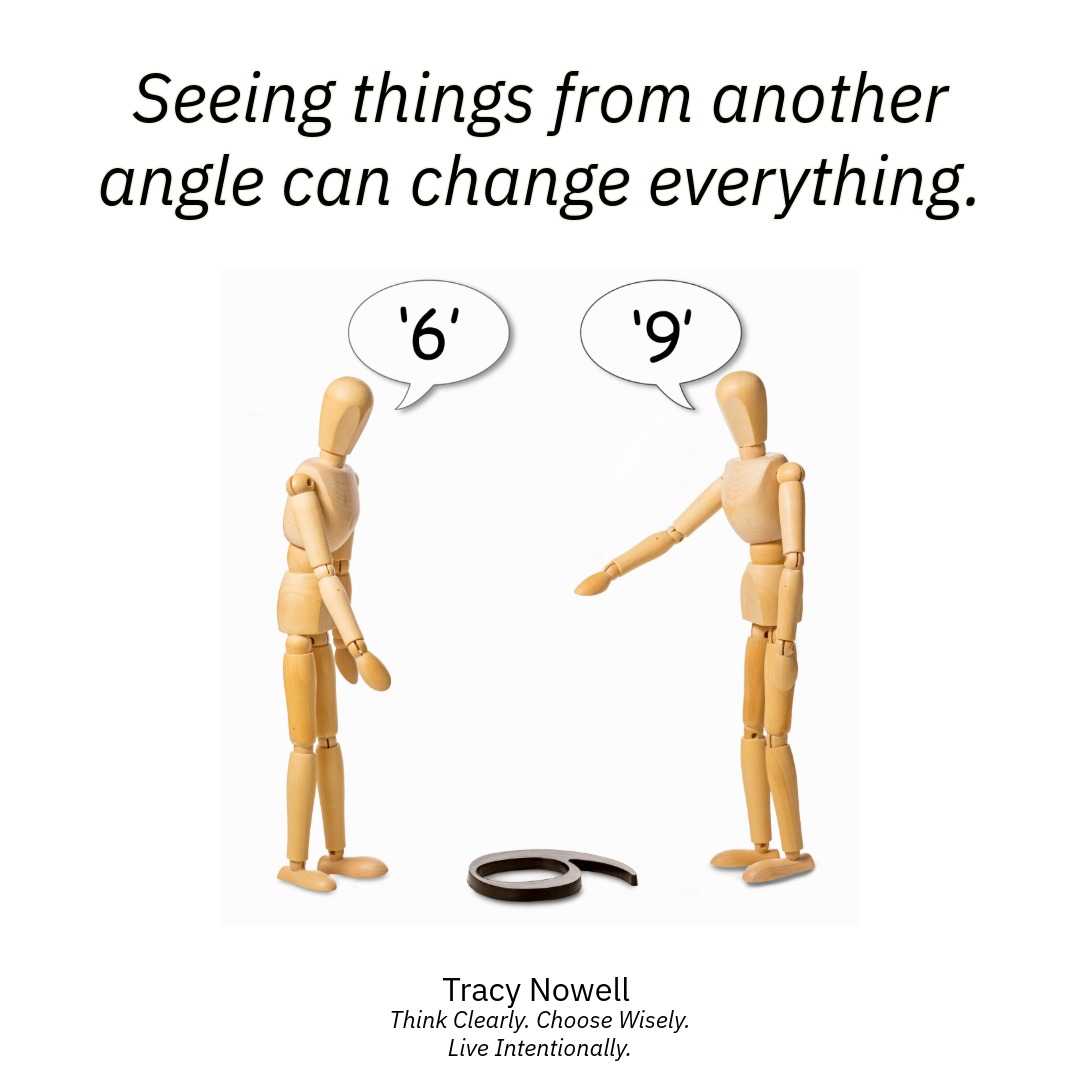
Imagine two people standing on opposite sides of a number written on the ground. One sees a six. The other sees a nine. Each person accurately describes what they see from their position. Neither has the complete picture because each views the same reality from a different perspective.
I've experienced something similar on the golf course.
On rare occasions, while looking down into my golf bag, I've picked up what I thought was my 6-iron only to discover it was actually my 9-iron. At a glance, the number can appear different depending on the angle, especially if the club has been placed in the wrong slot. Normally, I catch the mistake when I lower the club to the ground and notice the loft doesn't match the shot I intended. Looking at the club from a different angle immediately changes what I see.
If I fail to notice before I swing, however, my game plan may be right, and my swing may be good, but the result won't be what I expected. The problem wasn't my game plan. It was that I failed to verify that I was actually holding the club I thought I was.
Life often works the same way.
We naturally assume we are seeing reality exactly as it is when, in fact, we are seeing it purely from our own vantage point.
Perspective influences what we notice, how we interpret what we notice, and the meaning we assign to what we observe and experience. It impacts our thinking, our decisions, our relationships, and the direction of our lives.
The problem begins when we assume our perspective represents the whole picture and stop examining it.
When Our Perspective Becomes Our Reality
None of us sees life with complete objectivity.
Everything we have experienced contributes to the lens through which we view the world. Our upbringing, relationships, successes, disappointments, what we have been taught, beliefs, values, emotions and expectations all influence how we understand ourselves, other people, and the circumstances we encounter.
Experience is one of life's greatest teachers. It can also become one of life's greatest filters.
Without realizing it, we compare people to people we've known before. We interpret current situations through previous experiences, often drawing conclusions before we have enough information to understand what actually happened.
Sometimes those interpretations are accurate. Sometimes they are not.
An event occurs.
↓
We notice certain things.
↓
We interpret what we notice.
↓
We assign meaning to what we believe happened.
↓
Before long, our interpretation begins to feel like fact.
Consider something as simple as a friend not returning your phone call. The event is real. What we conclude about it may not be. We may assume they are upset with us, avoiding us, or no longer value the relationship. In reality, they may have been overwhelmed, dealing with a family emergency, or simply forgotten.
The event is factual. Our interpretation may or may not be.
This is the power of perspective. It influences not only what we see, but also how we interpret what we see, the conclusions we reach, and the decisions we make.
Because this process happens so naturally, we seldom recognize it as it takes place. Several common tendencies make it even more difficult to examine our interpretations objectively.
-
Strong emotions can narrow our perspective.
When we are hurt, frustrated, fearful, embarrassed, or heavily invested in a particular outcome, our perspective naturally narrows. We become more inclined to notice information that supports how we already feel while giving less attention to information that challenges it.
-
Pride can keep us from questioning our conclusions.
Once we become emotionally invested in being right, we often spend more energy defending our conclusions than examining them. We stop asking whether we may have overlooked something because changing our minds begins to feel like losing rather than learning.
-
Assumptions reinforce both tendencies.
When we stop questioning our assumptions, they gradually begin to feel like unquestionable facts. As a result, we tend to notice evidence that confirms our existing beliefs while overlooking information that points in another direction.
This helps explain why two people can witness the same event, hear the same conversation, or read the same email or text, yet reach entirely different conclusions.
"The first to present his case seems right, till another comes forward and questions him." - Proverbs 18:17 (NIV 1984)
The person telling the story may be sincere. They may even be largely correct. Even so, one perspective may not accurately represent the whole story.
The same principle applies whether the perspective is ours or someone else's. Sincerity alone does not determine truth. Every perspective should be examined in light of the evidence and what actually corresponds to reality.
Sometimes the issue is that we simply do not have all the facts. At other times, the information itself may be incomplete, inaccurate, or intentionally misleading.
In either case, both our interpretations and the information on which they are based deserve careful examination.
Testing Our Perspective Before Trusting It
If our perspective can become our reality, then one of the most important disciplines we can develop is learning to recognize when we may not be seeing things as clearly as we think.
Fortunately, our perspective is not fixed. Although none of us can eliminate every blind spot, we can become more intentional about examining our conclusions and remaining open to the possibility that we may not yet see the whole picture.
That begins with humility, which asks, “How might I be wrong”?
Humility does not require us to abandon our convictions. It allows us to hold our convictions while recognizing that our understanding may still be incomplete.
If we are willing to honestly consider that question, it naturally sparks curiosity -
“What might I be overlooking?”
Instead of trying to prove ourselves right, we become more interested in discovering what is true. Humility keeps our pride in check. Curiosity broadens our perspective.
Seeking wise counsel broadens our perspective even further.
Some of the best decisions I have made came after someone I trusted asked a thoughtful question or pointed out something I had overlooked. They didn't make the decision for me. They simply helped me see what I had not yet seen on my own.
Wise people don't simply give us answers. They help us ask better questions.
In addition, listening attentively creates the space to benefit from others' perspectives.
We can benefit from listening to another person’s perspective, even if we disagree with it. Attentive listening is more than remaining quiet while someone else speaks. It is the discipline of listening to understand rather than simply preparing our response.
Even if we continue to disagree, careful listening often exposes assumptions we have overlooked, corrects incomplete conclusions, and helps us evaluate our own perspective more accurately. In many situations, thoughtfully considering another person's perspective leads to a more complete understanding than either person might have reached alone.
Together, humility, curiosity, wise counsel, and attentive listening gradually refine our perspective. As our perspective becomes more informed, our thinking becomes clearer, our decisions become wiser, and our lives become more intentional. Rather than becoming more certain of everything we think, we become more committed to pursuing what is true.
Our perspective is too influential on our lives to leave unexamined. That is why it should be tested before it is trusted.
Final Thoughts
Looking back over my own life, I have learned that some of the most important lessons came from being willing to reexamine my perspective on a person, a situation, or a circumstance. That has been true in relationships, in business, in leadership, and even in my faith.
I learned that Scripture encourages us not to accept our first impressions or conclusions without examination.
1 Thessalonians 5:21 (NIRV) says -
"Put everything to the test. Hold on to what is good."
Instead of accepting our initial assumptions or interpretations as reality, we are called to examine them carefully and hold on to what proves true.
That requires us to be teachable - open, ready, willing, and capable of learning.
Proverbs 12:15 (NIV) says -
"The way of fools seems right to them, but the wise listen to advice."
Assuming our own perspective is sufficient closes the door to learning. Remaining teachable opens it.
That same attitude also changes how we listen.
James 1:19 (NIV) reminds us -
"Everyone should be quick to listen, slow to speak and slow to become angry."
Listening well gives us the opportunity to pause, consider another perspective, and resist the temptation to reach conclusions too quickly.
None of us sees every situation perfectly. We all view life through the lens of our experiences, strengths, weaknesses, successes, disappointments, beliefs, expectations, and assumptions. It is often through recognizing our own imperfections that some of life's greatest breakthroughs begin, because they reveal there is still more to understand.
That is why humility matters.
The pursuit of truth begins with the humility to question our own perspective.
So, the next time you find yourself convinced you already understand a person, a situation, or what happened, pause long enough to ask -
"How might I be wrong?"
"What might I be overlooking?"
They might just open your eyes and mind to something that changes your life in ways you never thought possible.