Principles versus Preferences: Why Guiding Principles Matter
Every one of us has preferences.
We also hold values and beliefs we consider important - what we believe to be right, worthwhile, and worthy of influencing how we live.
Although we may not think about it very often, our preferences and our principles tend to serve very different purposes.
- Our preferences reflect the things we like, want, enjoy or feel drawn towards. They influence our opinions, priorities, expectations, and the choices we make.
- Our principles express our values and beliefs as the standards we use to evaluate our decisions and direct our lives.
The challenge comes when our preferences and our principles point in different directions. In that case, which one takes precedence?
The answer tells us far more than the decision itself does, because it shows what truly guides our lives.
Why Preferences Often Take Precedence Over Principles
From the day we are born, every experience leaves an imprint on us. Our preferences begin developing through influences such as:
- Relationships - parents, siblings, teachers, coaches, and friends.
- Experiences - our successes and disappointments.
- Environment - our culture and the world around us.
Together, these influences contribute to the preferences we develop, and those preferences influence the choices we make.
Psychology helps explain why it is often easier to follow our preferences than our principles.
Preferences frequently align with what feels natural, familiar, comfortable, or immediately rewarding. Living according to our principles often requires us to slow down, exercise self-control, delay gratification, and consciously choose what we have already determined is right.
We also tend to notice information that confirms what we already believe while giving less attention to information that challenges our thinking. As a result, the preferences we have already developed become increasingly reinforced and more influential in the decisions we make.
Today's world amplifies this process.
Every day we are exposed to advertising, social media, news, political messaging, and online algorithms - all seeking to influence what we buy, what we believe, what we value, and how we behave.
The goal isn't merely to capture our attention. It's to influence our preferences.
Because much of this process occurs without our conscious awareness, we rarely stop to consider whether our preferences were intentionally chosen or simply developed through repeated influences. Consequently, they continue to be reinforced by whatever consistently captures our attention.
This helps explain why personal preferences often become far more influential than we realize.
Why Guiding Principles Matter
If our preferences naturally develop over time and are continually reinforced, something else is needed to help us evaluate them. Otherwise, our decisions become increasingly driven by what feels right, what seems desirable, or what offers the greatest immediate benefit, rather than by principles we believe in.
This is where guiding principles become essential.
They are not merely principles we believe. They are the principles we intentionally choose to live by. We use them as the standards against which we evaluate our choices.
- They become the guardrails that help keep us from drifting.
- The goal posts that define what success truly looks like.
- The directional markers that help us navigate difficult decisions when competing influences point us in different directions.
Without guiding principles, life easily becomes reactive.
We respond to whatever circumstances we face, whatever emotions we feel, or whatever preferences seem strongest in the moment. Decisions become increasingly situational because there are no predetermined standards against which to evaluate them.
They remind us that not everything we want is beneficial. Not everything that feels right is right. Not everything that is popular is wise. And not everything that offers immediate satisfaction is beneficial.
This does not mean our preferences are unimportant.
Many of them enrich our lives and reflect our personalities, interests, and individuality. The issue is not whether we have preferences or principles. We do. The issue is whether our principles consistently govern the decisions we make.
Most of us have principles we believe in. Far fewer have intentionally established them as guiding principles for the decisions that matter most.
The difference becomes evident when our preferences and our principles point in different directions. This is when our decisions truly reveal whether our principles are guiding our lives.
When Preferences Conflict with Principles
As long as our preferences and our guiding principles point in the same direction, decisions are easy - we prefer what is consistent with the principles we believe in, so there is little internal conflict.
The challenge arises when they don't.
We may prefer -
- Immediate gratification over long-term benefit.
- Comfort over discipline.
- Approval over conviction.
- Personal gain over integrity.
- The easier path over the wiser one.
These moments reveal whether our preferences and our guiding principles are truly aligned. When they are not, we have reached an important crossroads.
Will we adjust our principles to accommodate our preferences, or will we adjust our preferences to better align with our guiding principles?
Why does this matter?
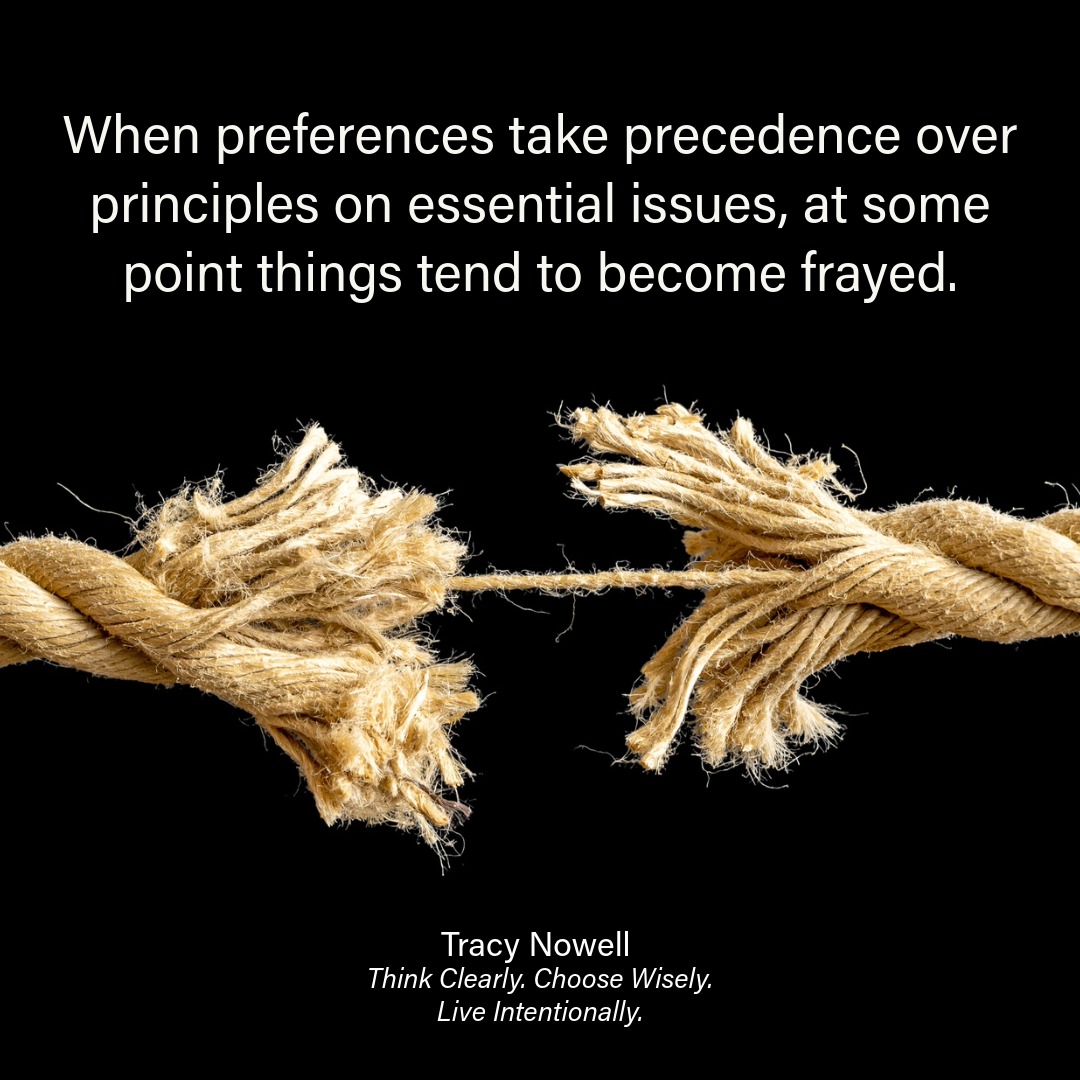
When our preferences consistently take precedence over our principles on essential issues, something begins to fray. It may be our peace, our relationships, our integrity, our character, and eventually even our identity.
Living contrary to what we believe is right gradually pulls us away from the person we desire to become.
Remaining out of alignment always comes at a cost because every meaningful choice requires a sacrifice. If we choose our preferences, we often sacrifice something our guiding principles were intended to protect - our integrity, our relationships, our health, our financial well-being, our character, or our peace of mind. If we choose our guiding principles, we usually sacrifice something we naturally desire in the moment - comfort, convenience, approval, immediate gratification, personal gain, or an easier path.
The question is not whether sacrifice will be required.
The questions are -
- What are we willing to give up?
- Is the cost worth it?
- What does our choice reveal about the person we are becoming?
This is why guiding principles matter so much.
They remind us that some things are simply more important than our immediate preferences. They help us distinguish between what we want in the moment and what ultimately serves the person we are trying to become or the goals we are trying to achieve.
Living according to guiding principles does not eliminate difficult decisions. It provides a consistent standard by which to make them.
Living According to Guiding Principles
Living according to guiding principles begins with intentionally establishing them.
These principles should not be chosen casually or simply accepted without examination. They should flow from what we know to be true, reflect the values and character we desire to live by, and remain consistent with the person we are striving to become.
Establishing guiding principles, however, is only the beginning. They become truly guiding only when they govern the choices we make.
That requires awareness - recognizing the influences competing for our attention and honestly evaluating whether they are drawing us toward or away from the life we want to live.
It requires focus - keeping our guiding principles at the forefront of our minds rather than allowing competing influences to determine our choices.
It requires discipline - choosing what we have already determined is right, even when another choice feels easier, more comfortable, or immediately rewarding.
And it requires consistency - repeatedly choosing to live according to our guiding principles demonstrates whether they have truly become the guiding principles by which we live or remain principles we merely admire.
Living according to guiding principles isn't about perfection. It is about consistently aligning our preferences with the principles we have intentionally chosen to live by.
That is what intentional living looks like.
Final Thoughts
Looking back over a lifetime of learning, I've come to see it this way -
- Preferences naturally develop.
- Principles are learned and sometimes embraced.
- Guiding principles are intentionally chosen.
Until our decisions consistently align with our guiding principles, they remain beliefs rather than principles we have integrated into our lives.
Much of life is spent developing preferences without giving equal attention to the principles that should guide them. Left unexamined, our preferences often become the default influence behind our decisions. Left unchallenged, they can gradually pull us away from the very values we claim to hold.
Over the years, I've read widely, learned from many people, and benefited from insights found in psychology, leadership, philosophy, and the experiences of others. Each has helped me better understand how we think, why we make the decisions we do, and what contributes to a meaningful life.
Yet after decades of studying people, leading organizations, coaching others, and examining my own life, I have found no source of guiding principles more enduring, more reliable, or more transformative than the Bible.
The more I have studied people and the decisions they make, the more convinced I have become that the wisdom of Scripture consistently aligns with what I have observed in life.
"No discipline is enjoyable while it is happening - it’s painful! But afterward there will be a peaceful harvest of right living for those who are trained in this way.” - Hebrews 12:11 (NLT)
Living according to guiding principles is not always easy because there will be preferences to overcome, sacrifices to make, and difficult choices to face.
Choosing our guiding principles over our immediate preferences is a form of discipline.
Every time we make that choice, we are training ourselves to live according to our guiding principles. I believe the "peaceful harvest of right living" described in this verse reflects the outcome of that training.
Our lives ultimately reflect what consistently guides them.
So, which is it for you - your principles or your preferences?