Reaching Your Full Potential Begins with Alignment, Not Increased Effort
What keeps people from reaching their full potential?
Many assume it's a lack of commitment, discipline, or effort. I once believed that myself. In my twenties and early thirties, I was convinced that working harder was the key.
So I kept pushing myself to do more and achieve more. From the outside, it looked like success. From the inside, however, something was missing.
I couldn't name it at the time - I only knew that success, by most external measures, wasn't producing the fulfillment I expected it to. The harder I pushed, the more disjointed and unfulfilled I became, as if life were directing me instead of the other way around.
Eventually, I reached a turning point. I started questioning everything -
- Why am I here?
- What is the purpose behind all I'm doing?
- Do my actions reflect the person I want to become?
- Are my priorities aligned with my values?
- Why do I feel restless and unfulfilled despite apparent success?
Through introspection, research, and conversations with a trusted counselor - and after plenty of trial and error - I discovered an important truth.
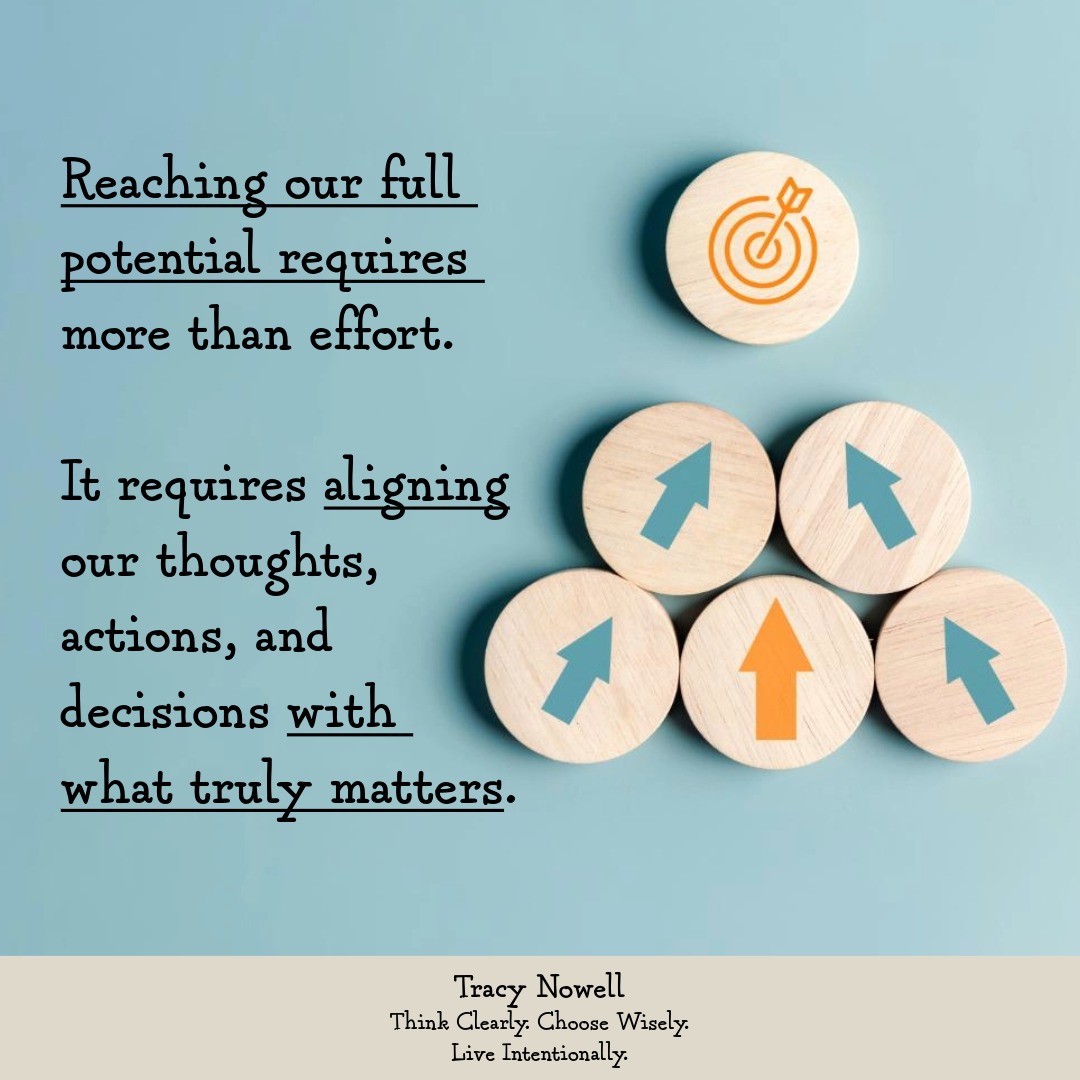
Reaching our full potential requires more than effort. It requires bringing our thoughts, decisions, and actions into alignment with what matters most.
The Key Components of Alignment
From what I've learned over a lifetime, alignment requires bringing six essential elements into harmony. Each serves a distinct purpose, but they work together to help align our thoughts, decisions, and actions with truth and what truly matters.
-
Core Values (Fundamental Beliefs)
Definition: The foundational convictions that define what we believe is right, what we consider important, and what we stand for - and that guide how we choose to live.
Why is this important?
Our core values and fundamental beliefs are grounded in what we have come to recognize as truth and provide the foundation for the guiding principles we choose to live by. Those guiding principles help us determine our priorities and then guide the decisions and actions that follow.
-
Giftedness (Inborn Strengths)
Definition: The unique, natural way you were created to function at your best, reflecting your inborn strengths and motivations.
Why is this important?
When you operate within your natural strengths, you experience greater fulfillment, resilience, and effectiveness. By contrast, working in areas that drain you can lead to frustration, inefficiency, and disengagement. You can be highly competent at something and even passionate about it, yet still be misaligned with your giftedness. Competencies, passions, and giftedness are not necessarily the same.
-
Vision (Direction)
Definition: A clear picture or sense of where you're heading that aligns with your core values, beliefs, and giftedness.
Why is this important?
When our vision is aligned with our core values, beliefs, and giftedness, it provides direction and focus, helping ensure our efforts lead to purposeful outcomes rather than aimless activity. Without that alignment, we can expend significant effort moving in a direction that limits our potential.
-
Mission (Purpose)
Definition: The underlying purpose that gives meaning to our lives and the deeper “why” behind who we seek to become and what we choose to do.
Why is this important?
When a well-defined mission aligns with our core values, beliefs, giftedness, and vision, it strengthens our commitment and helps sustain it in difficult circumstances.
-
Goals (Priorities)
Definition: Clearly defined objectives that reflect our vision and mission and become our priorities.
Why is this important?
Without clear goals, even the strongest vision and mission remain abstract. Goals provide direction, accountability, and a way to measure progress - the difference between simply hoping for something and actively working toward it.
-
Commitments (Guidelines)
Definition: The standards, disciplines, and promises we intentionally establish and commit to uphold to remain aligned with our values and beliefs, giftedness, vision, mission, and goals.
Why is this important?
Commitments provide guidelines and guardrails that help us remain consistent and aligned when distractions, pressures, or preferences pull us in another direction. By establishing our non-negotiables in advance, we are better prepared to avoid compromise when difficult choices arise.
When these six elements work together, they provide greater clarity about what guides us, how we were naturally wired to function at our best, where we are heading, why it matters, what we intend to accomplish, and the commitments we choose to make.
Alignment is not just about doing more - it's about doing what truly matters, with each element helping to inform and align the next.
Why Alignment Matters
-
Alignment Builds Resilience
Resilience is not just about bouncing back from setbacks; it's about remaining grounded in truth and the guiding principles we choose to live by. When we are aligned, that foundation provides an inner strength that helps us face challenges and uncertainty with greater confidence and remain steady when circumstances might otherwise pull us off course.
-
Alignment Supports Growth
Growth is not simply about moving forward; it requires moving in the right direction. As we learn, gain experience, and become more aware, we often recognize areas that need to change. Without realignment, however, what we learn may never be fully integrated into our priorities, decisions, and actions. Continued growth requires us to make adjustments, realign, and build upon what we have learned.
-
Alignment Drives Performance
When our efforts align with our guiding principles, priorities, vision, mission, and goals, we can focus our time and energy more effectively. Misalignment creates friction, inefficiency, and confusion, often requiring greater effort with less meaningful progress.
-
Alignment Impacts Our Results
The small, daily choices we make compound, affecting our long-term results. Even seemingly minor misalignments - compromising our values or pursuing priorities inconsistent with our goals - can create significant gaps between our efforts and measurable progress. Alignment helps ensure our hard work is directed towards achieving our desired outcomes.
-
Alignment Strengthens Our Influence
When our values, principles, decisions, and actions are consistent, others can more clearly see what we stand for and trust what they see. That consistency builds credibility and strengthens our ability to positively influence others. Misalignment, on the other hand, creates inconsistency that can weaken both trust and influence.
Final Thoughts
Alignment requires more than simply deciding we want something to change. It involves three important responsibilities -
- Choosing alignment - making the decision to align our lives with truth and what truly matters most.
- Defining alignment - identifying and aligning the elements that guide us, discovering how we were created to function at our best, and establishing direction, purpose, and accountability for our lives.
- Maintaining alignment - continually evaluating our thoughts, decisions, and actions for signs of misalignment and making the necessary adjustments.
Misalignment often begins with a gradual drift. We can drift from our values, beliefs and the guiding principles we have chosen to live by. Our priorities can shift. We can lose sight of our purpose and why it matters, and shirk the commitments we have made to ourselves.
As we drift, our thoughts, decisions and actions can increasingly be driven by circumstances, immediate preferences, the influence of others, the world around us or whatever feels right at the time.
I know because I lived it.
Years of gradual drift in my twenties had taken me further from my values, beliefs, and the person I wanted to be. I became so caught up in the turbulence of my life that, in many ways, I lost myself.
At the time, I can honestly say that I did not think in terms of alignment; I just knew I was missing something important. Eventually, my eyes opened to the fact that the real issue was not simply what I had drifted into, but who I had drifted from - God.
So, for me, realignment began with God.
“Seek the Kingdom of God above all else, and live righteously, and he will give you everything you need.” - Matthew 6:33 (NLT)
I needed to put my relationship with God first and align my life with Biblical truth and principles.
It wasn't easy, and the answers did not all come at once. I spent several years working with a trusted counselor to better understand how my relationship with God worked. I struggled to understand the intersection between my responsibility for my own life and God's role in it.
Through that process, I gradually came to see my faith differently - as a relationship, not a religion. That reframing changed how I understood my connection with God - both how I interacted with Him and how He interacted with me.
My pursuit of truth slowly led me back to God and the Biblical truth and principles I chose to fully trust - the anchor and foundation on which I began aligning my life.
My first personal mission statement, drafted in my early thirties, grew out of that process. It helped me clarify my values and beliefs, establish guiding principles, define my priorities, make commitments and create a clearer sense of vision and purpose. Gradually, the different areas of my life began to work together rather than against each other.
It was not until much later that I discovered how I was naturally designed to function at my best. Understanding my giftedness closed the loop.
I also discovered something else much later.
Fulfillment does not come from doing more; it comes from living in alignment with what truly matters.
Alignment does not eliminate hardship, uncertainty, or difficult choices. Nor does it guarantee the outcomes we hope to achieve. But it gives us a foundation for directing our efforts, making wiser decisions, and moving forward with greater clarity and purpose.
Take a Moment to Reflect:
- How might you benefit from living a more aligned life?
- Which elements of alignment might be missing?
- In what ways might you have lost sight of your purpose or why it matters?
- What might you have drifted from that you know should be guiding your life?
If you feel lost, stuck, unfulfilled, or uncertain about your next step, the answer may not be found in working harder. It likely begins by honestly examining where you have become misaligned and taking intentional steps to bring your life back into alignment with truth and what truly matters.