Mastering the Small Things to Achieve the Big Things
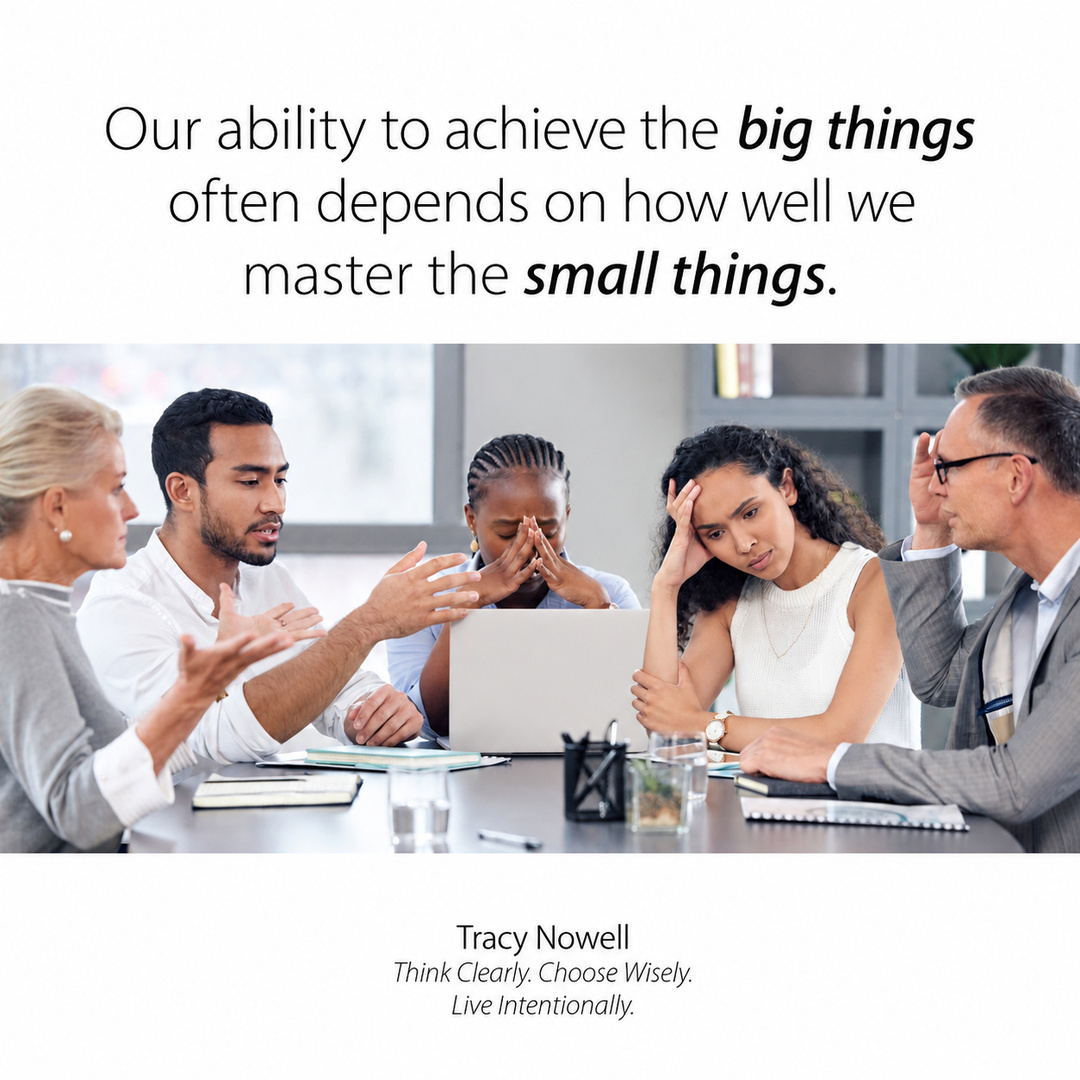
There is something exciting, and also challenging, about being young and inexperienced. We have enough optimism to believe we can achieve whatever we want, but we don't yet know what we don't know.
So we make plans, form expectations, and attach ourselves to dreams about our future and the big things we hope to achieve in our career, relationships, income, and lifestyle.
Then, inevitably, we reach a point where those plans, expectations, and dreams meet “real life.”
For most of us, that happens when we first venture out on our own and discover that much of our time and energy must be devoted to learning, earning, and surviving. This is when we begin to grasp just how much we still do not understand about life and what it requires of us.
We often learn the hard way that things are more complicated than we expected. Decisions are harder, reaching our goals takes longer, our roles and responsibilities increase, and we discover that life does not always conform to our plans, expectations, and dreams.
And when we focus too much on outcomes we think we can control, it is easy to get frustrated by what we do not anticipate and cannot control.
Hopefully, sooner rather than later, we learn to shift our attention toward the smaller things we can control - how we think, react, choose, act, and handle our responsibilities.
These small things matter, regardless of age or experience, because how we approach them influences our judgment, the patterns and behaviors we form, the trust we build, and the character we demonstrate as we take on bigger challenges and greater responsibilities.
The Influences Behind the Small Things We Often Overlook
The small things can be hard to notice because they are familiar, routine, and easy to overlook. More importantly, the influences beneath them can be even harder to recognize.
Some of those influences affect the way we think -
- Assumptions that can cause us to accept something as true without questioning their validity.
- Interpretations or perspectives that can influence how we perceive other people or situations.
- Mindsets that simply reinforce existing assumptions and perspectives.
- Emotions that can narrow our perspective and cloud our judgment.
Others affect how we react -
- Pride or defensiveness that can make it difficult to admit we are wrong, accept correction, or acknowledge fault.
- Insecurity or fear can make us feel threatened or exposed, and become overprotective.
- A need for approval that can make rejection or disapproval harder to handle.
- A desire for control that can affect how we react when things do not go as we want or expect.
Others affect how we choose -
- Preferences that can pull us toward comfort, convenience, safety, or what we want rather than what may be best or right.
- Priorities that determine where we direct our attention, time, energy, and resources.
- Common tendencies such as impatience, impulsiveness, avoidance, people-pleasing, or procrastination that can influence the choices we make, or avoid making.
And as our ways of thinking, reacting, and choosing become repetitive, they can show up in how we act -
- Habits that become ingrained through repetition.
- Patterns that develop from recurring ways of thinking, choosing, or acting.
- Behaviors that express these influences in how we conduct ourselves and affect others.
Unless something goes wrong or forces us to pay attention, we may not recognize whether the way we think, react, choose, or act works for or against our best interests.
- An assumption may be accurate or inaccurate.
- Defensiveness may be justified or excessive.
- A preference may be the best choice, or it may conflict with something that is more important.
- An action may be helpful and appropriate - or create unintended consequences.
That is why we need to examine these influences.
Examining the Small Things
As I discussed in my article, Truth and Reality, I have learned to examine situations like these by moving through a progression from awareness to discernment.
- Awareness - alerts us that something deserves attention.
- Question - explores what may be happening.
- Challenge - tests our assumptions, reactions, or conclusions.
- Truth - aligns us with what is actually true.
- Understanding - connects the dots, helping us make sense of what we are learning.
- Wisdom - discerns how we should respond.
The following two examples show how this can apply in everyday life.
1. Responding to Correction or Challenge
Suppose a boss, coworker, spouse, or friend points out what they believe is a mistake or questions the way something was handled.
Alert: I notice that I am feeling defensive.
Explore: What is driving my reaction? Is it pride, embarrassment, frustration, or fear of being wrong? Am I reacting to what was said or to what I think it implies?
Test: Am I being objective, or am I defending, deflecting, or protecting myself before determining what is actually true?
Align: What do the facts support? Is what was said valid, partly valid, or inaccurate? What responsibility, if any, do I have?
Connect: My defensiveness may be misdirecting me to focus more on protecting myself than considering the correction or challenge.
Discern: A better response may be to accept and acknowledge what is valid, correct what needs correcting, or calmly explain what is inaccurate.
This does not mean every critique or question is valid. It means slowing down long enough to consider the facts before deciding how to respond.
2. Preference Versus Principle
Suppose I have agreed to do something, but when the time comes, another option seems preferable or more appealing.
Alert: I notice that I am looking for a reason not to follow through on my commitment.
Explore: What is influencing me most - principle, responsibility, preference or what is most appealing in the moment?
Test: Is there a legitimate reason to change course, or am I rationalizing what I would rather do?
Align: Why did I make the commitment, and what principle should guide my decision?
Connect: What are the ramifications if I do not keep it? If I repeatedly let preference override principle, I undermine my commitments, priorities, and character.
Discern: The better choice may be to keep the commitment, or change course if the circumstances genuinely justify it.
This does not mean we must keep every commitment regardless of circumstances. It means distinguishing a legitimate reason for changing a commitment from a preference that simply makes another choice more appealing.
The same process can apply to other small things that deserve attention - avoiding a difficult conversation, reacting impatiently, reaching a conclusion based on an assumption or emotion rather than the facts, allowing an unimportant urgency to override a priority, or repeating a behavior that affects a relationship or responsibility.
How the Small Things Influence the Big Things
The small things of everyday life - how we think, react, choose, act, and handle our responsibilities - have benefits or consequences, and over time they can improve or hinder our ability to achieve the bigger things we pursue.
Repetition can compound the effect. Often-repeated ways of thinking, reacting, choosing, and acting can become habits, patterns, and behaviors that either work for us or against us.
The cumulative effect of the small things - including the habits, patterns and behaviors they form - can give others a broader picture of who we are. They can reveal whether we are rational or reactionary, thoughtful or impulsive, respectful or dismissive, dependable or inconsistent, responsible or careless, accountable or defensive.
Those are the qualities people often consider when evaluating our judgment, self-control, and character, and whether they can trust us, rely on us, respect us, work with us, or entrust us with greater responsibility.
Therefore, I have come to believe that our ability to pursue, achieve, and sustain many of the big things - strong marriages, close families, successful business relationships, greater responsibility, career success, financial security, and the trust and respect of others - often depends on how well we master the small things and the influences that affect them.
Final Thoughts
When I first wrote this article, and again as I rewrote it, Jesus’ teaching in the Gospel of Luke and what I had learned through experience were foundational to my thinking.
In Luke 16:10-12, Jesus points to faithfulness, stewardship, trustworthiness, and integrity in the way we handle the responsibilities entrusted to us.
“If you are faithful in little things, you will be faithful in large ones.” - Luke 16:10 (NLT)
How we handle what seems small can demonstrate the faithfulness and character we bring to greater responsibilities.“And if you are untrustworthy about worldly wealth, who will trust you with the true riches of heaven?” - Luke 16:11 (NLT)
How we handle our money and possessions reflects whether we can be regarded as trustworthy stewards.
“And if you are not faithful with other people’s things, why should you be trusted with things of your own?” - Luke 16:12 (NLT)
How we handle what belongs to someone else can demonstrate whether we are responsible, trustworthy, and good stewards of what has been placed in our care.
To broaden this further, the following verses in Titus speak about how we are called to live.
“In all things show yourself to be an example of good deeds, with purity in doctrine, dignified, sound in speech which is beyond reproach, so that the opponent will be put to shame, having nothing bad to say about us.” - Titus 2:7-8 (NASB 1995)
Moving beyond the Biblical context of these verses and considering how their teaching applies to the subject of this article, I see a practical challenge for everyday life -
- Making the effort to think before we react, choose, and act so that we are doing our best to do what is right.
- Allowing truth and sound guiding principles to direct our thinking and decisions.
- Conducting ourselves with humility, respect, dignity, and self-control.
- Speaking and acting in ways that are truthful, consistent, and not self-serving or hypocritical.
Taken together, these verses taught me that how we think, react, choose, act, and handle what has been entrusted to us matters greatly - not just in the small things or the big things - but in all things.
If you’d like to connect, I’m here to listen. No pressure—just a conversation.