When Life Feels Off: The Disconnections We Tend to Overlook
Life can look fine on the surface and still feel off.
Nothing appears to be broken. We show up, fulfill our responsibilities, tackle challenges, and keep things moving.
Yet in the places and times that matter most, something happens that surprises or frustrates us.
- A conversation at work goes differently than expected.
- Tension in a relationship keeps resurfacing.
- A decision makes sense in the moment, but leads somewhere we did not intend.
- A reaction to a situation feels right, but only makes things worse.
We adjust, try again, and keep moving, but the same patterns often return in different forms.
When that happens, it is natural to look for the problem outside of us - something that needs to be fixed, changed, or managed. And sometimes that is true.
But not always.
I have found that there are times when the issue is not just what is happening around us, but what we anchor ourselves to - or are disconnected from - and how that influences how we interpret what happens and how we respond.
When life feels off, it is often not just one issue. It is a series of disconnects - sometimes minor, other times more significant - that we do not always recognize.
Where the Disconnect Begins
I think most of us would say we are confident in our understanding of what drives our thinking, decisions, and actions.
And when the results don't line up, we look for answers but often can’t find them.
Why?
Because the answer is often found within us - a disconnect at the root of why life feels off.
And it may not be just one disconnect, but several that work together.
- Identity - who we say we are and how we show up
- Interpretation - what we believe and what is true
- Response - reacting versus responding intentionally
The reality is that, for most of us, these disconnections are hard to identify on our own because our first reaction is to look outward rather than examine ourselves.
How We See Ourselves (And How We Actually Show Up)
We may believe we know who we are. But what we believe about ourselves and how we actually show up do not always align. When that gap appears, it usually points to something we have not fully clarified.
Our identity is either clearly defined or it’s not, and everything else tends to reflect that.
When our sense of who we are - our values, beliefs, and guiding principles - is clear, aligned and integrated into our lives, it creates stability and consistency. There is a direct connection between how we see ourselves and how we show up.
When it is not, we begin adapting to -
- Expectations - of ourselves and others
- Our differing roles in life.
- Pressure or stress.
- What others think or feel.
- What seems necessary in the moment.
Slowly, that adaptation becomes a pattern, and that pattern creates a disconnect.
Authenticity is less about how much of ourselves we share and more about whether we are consistent across environments.
This is where the gap becomes visible. We show up one way in one setting and another somewhere else. Over time, that lack of connection makes it harder to stay consistent and harder for others to know who we really are. Those closest to us often see it first in the difference between what we say and what we do.
When what we believe and how we live do not align, that gap reflects a broken connection.
When those values, beliefs, and guiding principles are not clearly established and lived, there is nothing to anchor us - and we are easily pulled in other directions. And at some point, the difference between who we believe we are and how we actually show up becomes difficult to ignore.
Reflection Question: Where might there be a gap between how I see myself and how I actually show up?
How We Interpret What Happens (And Whether It Reflects Reality)
How clearly we see ourselves, others, and our circumstances depends on how accurately we connect our interpretations of what happened to what is actually true - something we don’t usually stop to question.
The assumption that we always see things clearly is worth examining.
Clear thinking requires us to examine whether there is a gap between our interpretation and what actually occurred. Without it, that connection is never made, blind spots remain, and assumptions fill in what is left unexamined.
Emotion influences our interpretation of what we see more than we realize.
When we don’t examine and question it, emotion can lead us to trust what we feel over what is actually true. Past experiences can reinforce that feeling and distort how we interpret the present.
What we see clearly about ourselves is not always what we choose to act on.
We can recognize patterns in how we interpret situations - jumping to conclusions, assuming intent, or reacting emotionally or defaulting to past experiences - and still do nothing about them, allowing the disconnect to continue.
Reflection Question: Am I responding to what is true - or to what I assume is true?
How We Respond and Function (Reactively or Intentionally)
How we operate day to day reveals whether we are living intentionally or simply reacting to events, people, or circumstances.
Reactive living keeps us busy, but often steers us away from what matters most.
When we live reactively, we get pulled toward what feels urgent rather than what is most important, and over time, that pattern becomes the default. We function on autopilot, guided by unchecked patterns rather than taking intentional control - and the disconnect grows.
Alignment - not activity - is what creates meaningful progress.
When our actions are connected to what matters most, they carry purpose. When that connection is missing, we may stay busy, but we are not necessarily moving in the right direction.
We do not learn from experience unless we intentionally evaluate it.
When we fail to examine how our choices are producing our outcomes, the connection is never made, and experience simply repeats itself. Tracing outcomes back to their source is uncomfortable, but it is what allows experience to guide us towards growth.
Reflection Question: Am I reacting to what is urgent, or intentionally choosing what matters most?
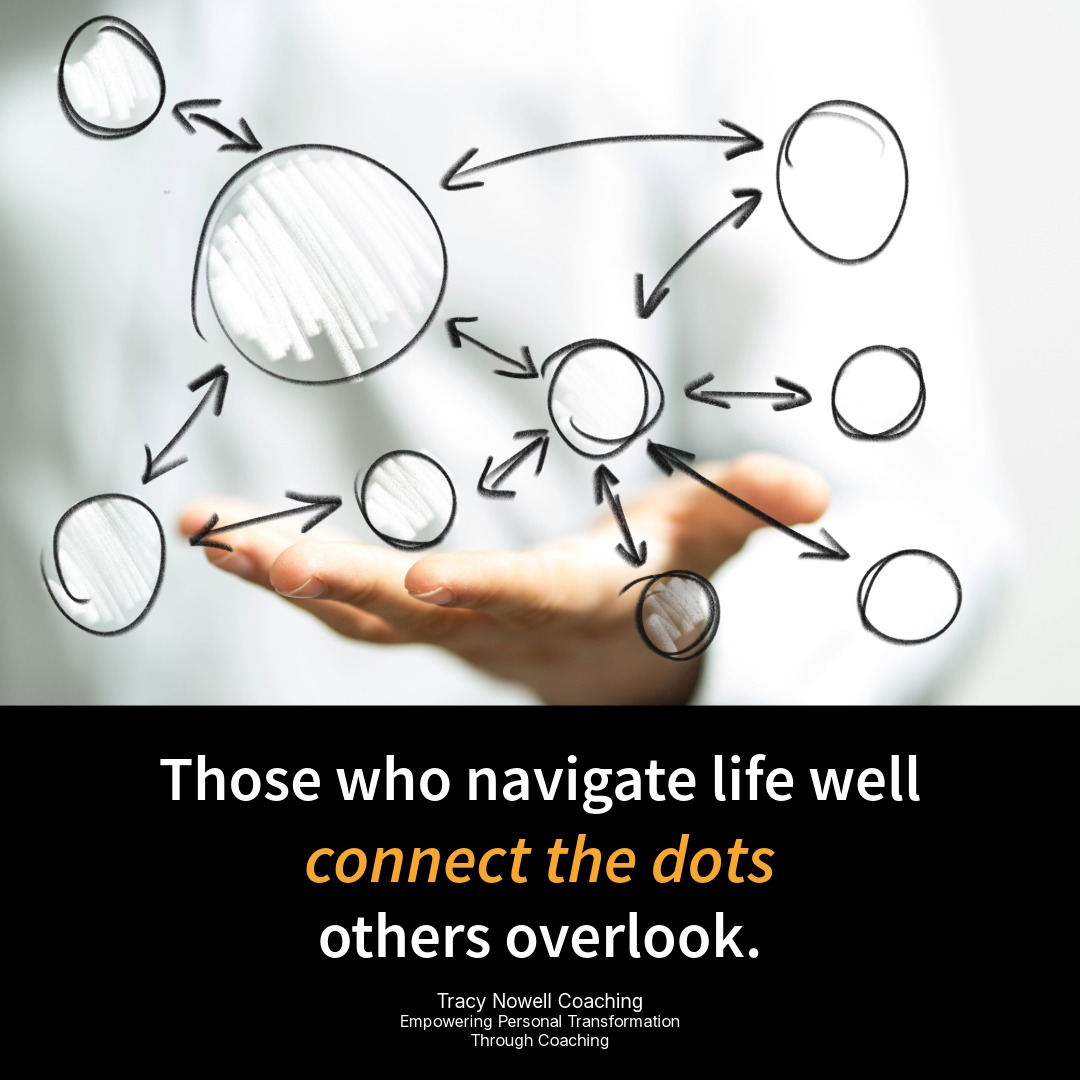
Connecting the Dots
Most of us can identify the symptoms of a life that feels off. Far fewer of us see that our sense of who we are, how we interpret situations and how we respond are connected to the outcomes we experience.
Connecting the dots requires discernment - not by overthinking everything, but by slowing down enough to question what we are seeing and feeling and test it against what is actually true.
At first, we often see only pieces - what happened, how we interpreted it, how we responded and what resulted - but not how they fit together. Over time, with honest examination, those connections begin to form. Often, it takes an outside perspective to help us connect the dots.
We begin to see -
- the gap between how we see ourselves and how we actually think, speak and act
- how our assumptions influence our interpretations
- how our interpretations drive our decisions
- how our decisions produce the outcomes we experience
Without this kind of examination, we tend to repeat the same patterns. With it, clarity grows, and our thinking, decisions and actions become more intentional.
Final Thoughts
The hardest thing to see is what we are most certain we already know or understand. We can change what we do and still never examine why we keep arriving at the same place.
The reason is often simpler than we want to admit.
We do not always know ourselves as well as we think, see things as clearly as we assume, or act as intentionally as we believe.
And without examining any of them, the patterns simply continue.
I have seen this in my own life. Early on, I learned that my thinking was not as reliable as I assumed - I could feel certain and still be wrong.
Scripture confirmed what I experienced.
"The heart is deceitful…Who can understand it?" - Jeremiah 17:9 (NIV)
"Trust in the Lord with all your heart, and do not depend on your own understanding." - Proverbs 3:5 (NLT)
Humility required me to consider the possibility that I could be wrong, even when everything in me said I was right.
And Scripture reinforced that.
"Anyone who claims to know all the answers does not really know very much." - 1 Corinthians 8:2 (NLT)
Or more pointedly, in a different translation -
“…sometimes our humble hearts can help us more than our proud minds." - 1 Corinthians 8:2 (MSG)
Living reactively meant letting circumstances, external pressures, and flawed interpretations drive my decisions and actions.
The following verse reframed that in a way that hit home.
"Be very careful, then, how you live - not as unwise but as wise" - Ephesians 5:15 (NIV)
But the most foundational shift came from Jesus’ own words -
"I am the vine; you are the branches…" - John 15:5 (NIV)
What drives our thinking, decisions, and actions is not just what is happening around us - it is what we are connected to - or disconnected from.
From decades of experience, I learned that when I drift from God - the true source of my identity, strength, and guiding principles - I default to reactive living. When I stay connected, my thinking becomes clearer, my decisions more grounded, and my actions more intentional. Life is not necessarily easier, but it is more aligned.
That is the connection that changed everything for me.
Whatever anchors you - your faith, your values, your guiding principles - the real question is whether you are truly connected to them, or not.
So, what disconnections might you be overlooking?
And even more important -
What are you connected to?