Focus: The Discipline of Directing Our Attention Toward What Matters Most
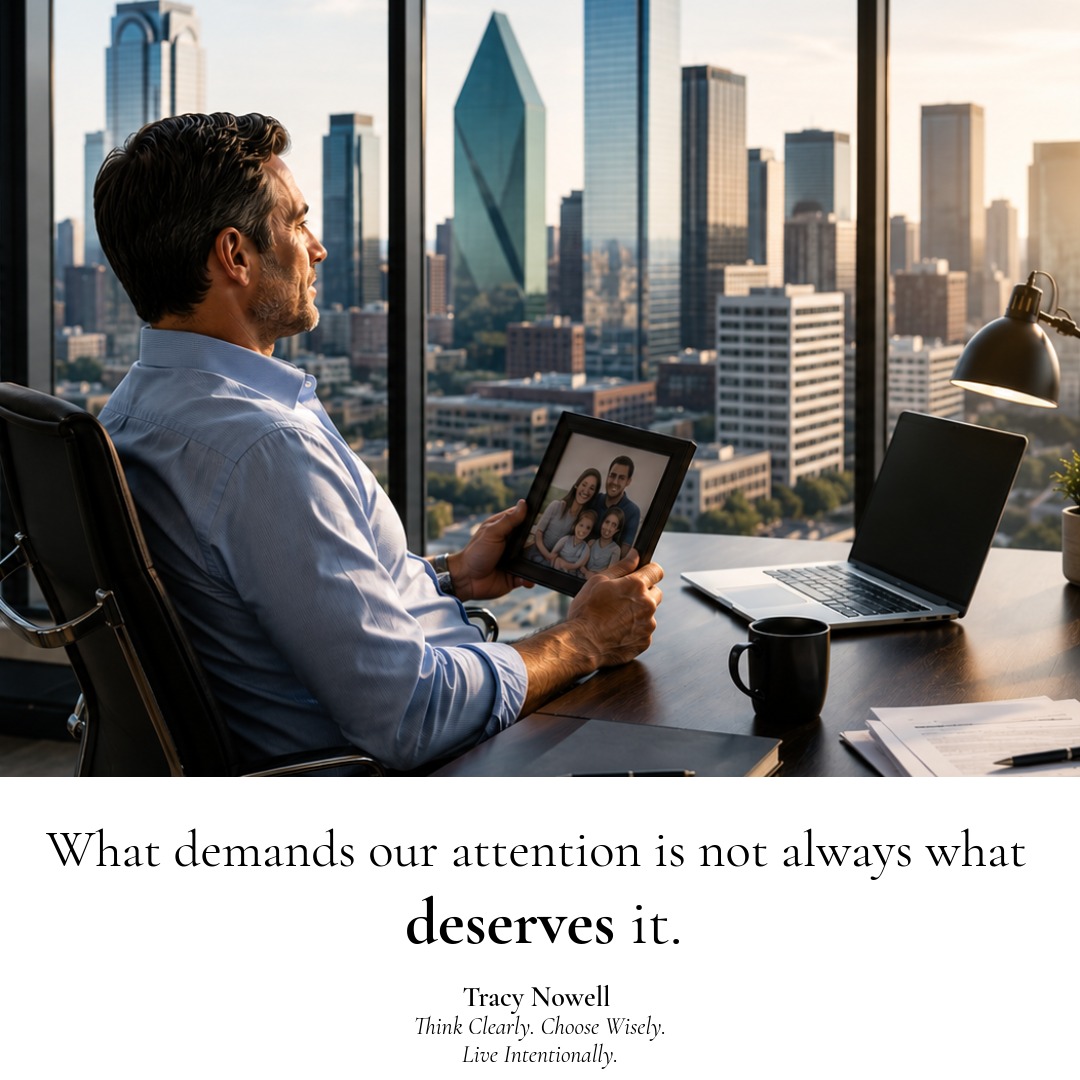
Most of us don't drift in life on purpose. It just happens.
Competing priorities, constant distractions, and mounting demands that feel urgent but may not be important can gradually consume our lives.
When I find myself drifting - when I don’t seem as productive, as effective or as in control of myself as I know I can be - the issue is rarely a lapse in my work ethic. More often, it is the opportunities, obligations, and urgent needs - things that feel legitimate in the moment - that slowly pull my attention away from what matters most.
When that happens, my life begins to feel scattered and off course. Rather than intentionally directing my attention, I find myself reacting to whatever demands it.
And at the root of misdirected effort is almost always one thing -
A lack of focus.
The challenge is that focus is not a one-time decision. We are constantly choosing how, where, and when to invest our attention, time and energy.
And on a bigger scale, most of us are not choosing between good and bad. We are choosing between good and good - between family and career, between relationships and responsibilities, between what is urgent today and what is important for the long term.
These are not simply scheduling problems. They are decisions about what truly deserves our attention. That is why a lack of focus matters more than we sometimes realize.
What Focus Actually Is - and What It Isn't
Focus is the ability to direct and concentrate our attention on a particular object, thought, task, person, or objective while giving less attention to competing priorities, demands, and influences.
While that definition is accurate, it does not fully capture the role focus plays in our lives. The real challenge is determining what deserves our attention and what does not because our capacity is limited. Every decision to focus on one thing is also a decision not to focus on something else.
Therefore, focus is a stewardship issue, not merely a productivity issue.
And what consistently receives our attention influences our thinking, decisions, actions, and ultimately the direction of our lives.
We also need to recognize some of the ways focus is commonly lost.
Divided Attention (Multitasking)
Doing several things at once may feel efficient, but divided attention rarely yields the same quality as directed attention. By trying to do too many things, we often diminish the effectiveness of each one.
Misplaced Attention (Minutiae)
Focus is often lost when we become preoccupied with less important things. We can spend considerable time on tasks, distractions, and activities that keep us busy, but achieve little, if anything.
Undisciplined Attention (Information Overload)
We are surrounded by more information and competing voices than ever before. Without discernment, more information often produces more confusion than clarity.
Unmanaged Attention (Autopilot)
Habits, emotions, thought processes, and external influences often direct or redirect our attention without conscious thought. Left unmanaged, our attention tends to follow the path of least resistance rather than the path of greatest importance.
Focus is the discipline of deciding what deserves our attention and continually returning to those priorities when life pulls us away from them.
What Focus Requires
Before we can focus on what matters most, we must first determine what is most important and why. That requires clarity regarding our values, convictions, priorities, and sense of purpose.
Choosing What Deserves Our Attention
While some demands are legitimate and require an immediate response, others simply compete for our attention.
Intentional focus requires us to ask - “Does this deserve my attention, time, and energy right now, and does it align with what matters most?”
Not what is demanding my attention, but what deserves it. Demands come from outside us. Deserving is determined from within.
This is fundamentally a stewardship question. What we consistently give our attention to reveals what we actually believe is most important - regardless of what we say we believe.
Filtering What Doesn't Belong
The first part of intentional focus is deciding what belongs. An equally important part is deciding what does not.
Every day, we are exposed to information, opinions, emotional reactions, competing demands, and noise. Not everything deserves equal consideration.
Much of what competes for our attention feels important, or at least urgent. Without filtering, our focus becomes fragmented.
Filtering is not about becoming closed off. It is about becoming more discerning. Learning to recognize what doesn't belong and filtering it out is one of the most underrated disciplines of focused living.
Broadening or Narrowing Perspective
Focus requires the ability to broaden or narrow our perspective as circumstances require. It involves examining situations from multiple angles and considering both the details and the larger context in which they exist. When we lose that flexibility, we often become overly focused on one aspect of a situation at the expense of others.
Some people become preoccupied with individual parts of a situation and lose sight of the whole. Others focus primarily on the whole and overlook important details.
- A leader or business owner must address today's challenges while keeping broader objectives in view.
- A parent must respond to daily demands while remaining mindful of longer- term priorities.
- In relationships, we must address disagreements and frustrations without losing sight of the value and dignity of the person involved.
- Being Fully Present
- Refocusing As Circumstances Change
- Choosing Intention Over Autopilot
Both approaches create problems - just different ones.
Perspective influences both what captures our attention and how we interpret it.
Facts matter, but so do patterns. Events matter, but so does context. Sometimes the challenge is not seeing more - it is seeing more accurately. We can become so focused on a single event, problem, or perspective that we miss the larger reality surrounding it.
Knowing when to zoom in and when to zoom out is not a natural skill for some, but it can be developed through experience, reflection, and a willingness to consider situations from multiple perspectives.
Focus influences how well we listen, observe, learn, understand, and connect with others.
There are times we move through conversations, decisions, and relationships on autopilot. We hear words but miss the meaning. We observe behavior but miss patterns. We listen for an opportunity to respond rather than seeking to understand.
Being fully present requires more than physical presence. It requires mental and emotional engagement - giving full consideration to the person in front of us, the decision before us, or the responsibility at hand.
Presence often reveals things we would otherwise miss, helping us better understand people, recognize opportunities, identify problems sooner, and respond more thoughtfully. I have learned, the hard way, that some of my most significant mistakes occurred when I was not fully present or focused on the right things.
Based on my experience, the people who make the greatest impact are often those who have learned to be genuinely attentive. Presence is not passive. It is one of the most active expressions of focused living.
Focus requires continual adjustment. It involves recognizing when we are out of focus, when our attention has drifted, and when circumstances require us to redirect, broaden, narrow, or reframe our focus.
Life changes and circumstances shift in ways we do not anticipate. When they do, even the most intentional person can find their focus disrupted.
Sometimes that means returning to a neglected priority. Other times it means adapting to new realities, responsibilities, or opportunities.
In either case, intentional living requires us to periodically reassess where our resources are being invested and ensure they remain aligned with what is most important.
The difference between intentional focus and autopilot is the difference between living purposefully and living reactively.
When we fail to intentionally direct our attention, we become increasingly reactive to our circumstances, emotions, fears, and others' expectations.
Intentional focus requires us to pause long enough to examine what is influencing us. This involves questioning unproductive patterns, challenging unexamined assumptions, and deliberately redirecting attention toward what we have already determined matters most.
Final Thoughts
In a world filled with competing demands, few disciplines are more important than focus. Without it, even our best intentions get absorbed by the pace, pressure and noise of life.
A focused life is not one with the fewest distractions. It is one built around clear priorities and the discipline to keep returning to them when competing demands pull us away.
As someone whose life is guided by Scripture, I find that two passages have most influenced my thinking about focus.
The first is Proverbs 4:25-26 (NIV) -
"Let your eyes look straight ahead; fix your gaze directly before you. Give careful thought to the paths for your feet and be steadfast in all your ways."
For me, this is a picture of concentrated attention - staying fixed on the path, exercising discernment, and refusing to become distracted by competing demands.
The second comes from Philippians 3:13-14 (NLT), where Paul writes about his own life.
“I focus on one thing: Forgetting the past and looking forward to what lies ahead, I press on to reach the end of the race and receive the heavenly prize for which God, through Christ Jesus, is calling us.”
Where Proverbs speaks to attention, Paul speaks to singular focus - the discipline of setting everything else aside and aligning ourselves with what is most important in life.
I believe every life has some form of a central focus, whether we know it or not. What occupies that place influences everything else.
When we learn to direct our attention toward what truly deserves it - filtering what doesn't belong, holding the right perspective, being fully present, refocusing when we drift, and choosing intention over autopilot - we begin to think more clearly, choose more wisely, and live more intentionally.
Because what consistently receives our attention will influence not only the direction of our lives but also the impact our lives have on others.