Humility in Life and Leadership: The Cornerstone of Lasting Impact
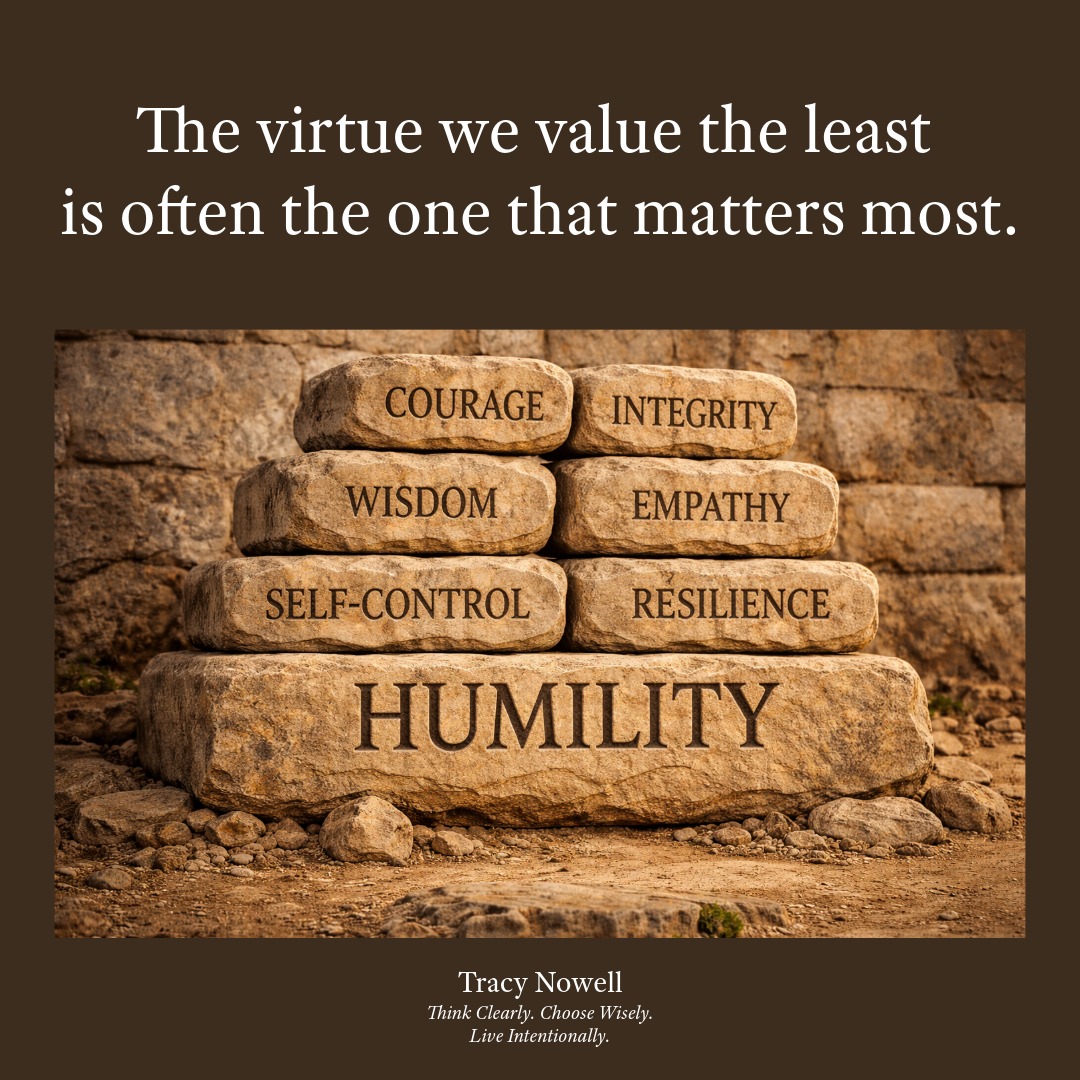
As we move into a new year, I’ve noticed that some people choose a single “word” to guide the year ahead - a theme meant to orient their focus. I’ve never done that myself. But as I reflected on life and leadership, relationships, work, and the patterns I’ve seen repeated over time, I found myself asking a simple question -
If there were one quality or virtue that consistently sits at the foundation of lasting “impact” in life and leadership, what would it be?
There are many qualities we admire in people that impact our lives - integrity, courage, wisdom, empathy, resilience, and self-control. From what I have learned, these virtues have guided moral thought, leadership ideals, and human behavior for centuries.
Yet the more I’ve lived, led, coached, and observed the world around me, the more convinced I’ve become that one virtue undergirds them all.
Humility.
It’s not the virtue many people seem to lead with, nor is it one our culture prioritizes. And this isn’t something I’ve observed only in others - it’s something I’ve had to confront in myself - and learn from.
Much of our maturing, I’ve discovered, comes through humility learned the hard way.
That’s why I’ve come to see humility as the foundation on which every other virtue stands - keeping us open, teachable, and grounded.
Without humility, even the strongest virtues can distort. Humility interrupts that distortion by keeping each virtue aligned with its proper purpose -
- courage from lurching into recklessness
- wisdom from sliding into arrogance
- integrity from being applied selectively
- empathy from turning into performance rather than sincere connection
- resilience from hardening into stubbornness
- self-control from becoming self-serving
When humility is absent, the virtues that strengthen us don’t disappear - they begin to work against us rather than for us.
Why Humility is Hard to See and Easy to Miss
We live in a culture that often misreads humility as weakness. It’s frequently mistaken for insecurity, a lack of confidence, or a lack of boldness - which makes sense in our power-centered, “me”-oriented world.
And yet, humility is no more a weakness than pride or arrogance are genuine displays of strength.
What we see modeled isn’t confidence, but something closer to hubris - an overconfidence that resists limits, correction, and self-examination.
What makes pride especially difficult to recognize in ourselves is that it rarely feels personal. We tend to see it clearly in others, but far less easily in ourselves. Instead, it often hides behind language that sounds reasonable - even admirable.
“I’m just being real,” yet struggles to accept feedback without defensiveness.
“I’m protecting my boundaries,” but uses distance to avoid accountability.
“I’m standing on my principles,” while becoming rigid and unwilling to listen.
“I know what works best,” but resists input or correction.
These patterns don’t usually feel extreme or dramatic. They’re subtle. Familiar. And because they’ve become so common, they feel normal.
This is the environment in which humility is easily overlooked - not because it lacks strength, but because it doesn’t compete for attention.
Two Ways of Living - The Illusion of Strength and the Reality of It
Over time, I’ve observed two broad, recurring approaches to life.
The first attempts to “project” strength. It tends to react impulsively, resist correction, speak with certainty, deflect responsibility, and be driven by the need to be right or validated. It may appear confident on the surface, but it is often fragile beneath. Conflict can become a form of self-protection, with managing perception taking precedence over truth.
The second way is more observant, aware and steady. It pauses before reacting, seeks understanding, admits mistakes, adjusts when necessary, and values truth over appearance. It isn’t concerned with looking strong - it is strong, because it’s anchored in reality rather than ego.
What explains the difference between these two paths?
Humility is strength under control. Not projected strength, but authentic strength.
This difference is not about personality or style, but posture. It’s about how honestly and objectively we face reality - by becoming aware of what is happening within us and around us.
From that posture, humility grounds a person. Freed from the need to protect ego or image, emotions steady, perspective sharpens, and people become more teachable and accountable - guarding against self-deception that pride makes almost inevitable.
And when we finally recognize that the world does not revolve around us, we open the door to a more grounded and impactful version of ourselves.
What Humility Looks Like in Real Life
Humility is not proven by how well we can talk about it or display it, but by how it is lived. It is revealed in how we respond - especially under pressure.
Personally, humility shows up in how honestly we relate to and evaluate ourselves. It allows us to name patterns that no longer serve us without excusing them. Growth becomes possible not because we are harsh with ourselves, but because we are honest.
Relationally, humility changes the tone of our interactions. It listens without focusing on what to say next. It engages rather than retreats when tension arises. It holds conviction without the need to dominate. Trust deepens because ego no longer runs the show.
In our work, humility shows in a willingness to learn and course correct. It seeks understanding before certainty, and correction before failure. Humble people listen carefully, accept feedback without defensiveness, and take responsibility when they get it wrong. Growth comes not through self-promotion, but through steady improvement, competence, and follow-through.
In leadership, humility may be the clearest example of strength under control - authority exercised without entitlement, responsibility carried without ego. Humble leaders don’t rely on position to command trust - they earn it. They create environments where people can speak honestly, grow freely, and contribute meaningfully.
They don’t lead by knowing everything, but by knowing who to listen to. They invite feedback, welcome better ideas regardless of the source, and let discernment - not ego - guide decisions.
In every arena, humility keeps us honest - about ourselves, others, and the responsibility carried. This honesty is what allows growth to take root and impact to deepen over time.
Humility as a Biblical Operating Principle
What I’ve described throughout this article isn’t a new insight or a personal theory. It reflects a consistent pattern Scripture has long pointed to - one that places humility at the beginning of wisdom, growth, and right living, not at the end.
The Bible presents this pattern clearly -
- Humility precedes wisdom and honor. Scripture places humility before wisdom and honor, as a condition that makes them possible. (Proverbs 11:2; 15:33).
- Humility is the posture from which growth begins. Jesus spoke of humility not as weakness, but as the posture from which learning and inner renewal begin (Matthew 11:29). Growth starts with openness to being taught, not the assumption that we already have it all figured out.
- Pride and humility produce opposite outcomes. Jesus said it plainly - “Those who exalt themselves will be humbled, and those who humble themselves will be exalted.” (Luke 14:11)(NLT) From a worldly perspective, this doesn’t always appear true in the short term. Over time, however, pride and humility tend to lead to very different outcomes.
- Grace is received through humility - it is not earned through self-effort, achievement, or standing. “God opposes the proud, but gives grace to the humble.” (James 4:6; 1 Peter 5:5)(NLT). Pride closes us off; humility keeps us open and receptive.
Taken together, Scripture points to a consistent operating principle -
Humility is not an outcome of right living - it is a doorway to it.
Final Thoughts
Humility may be countercultural, but it is an empowering way to live.
- It keeps us open to learning and change.
- It strengthens relationships by lowering walls that block authentic connection.
- It encourages a leadership style that serves rather than rules over others.
- It sustains influence because people ultimately gravitate toward character, not ego.
When I look at the world today, I don’t think we are facing a shortage of intelligence or talent. We are facing a shortage of authentic humility - and I believe that deficit sits near the root of many of the fractures we see in individuals, relationships, workplaces, and the world at large.
Not because we don’t value humility, but because living it consistently asks more of us than we often realize. It requires an integrated self - one that doesn’t bend to ego or retreat into safe compartments when facing hard truths about ourselves.
Humility is also a spiritual foundation. It takes a humble heart to know God and enter into a relationship with Him. Without humility, we have little reason to acknowledge our limits, our dependence, or our need for something beyond ourselves.
Humility opens us to the reality that we are not God - that our control is limited, and that truth exists beyond our own perspective.
That same posture of humility carries into how we relate to others and how we exercise influence in the world.
In my experience, our maturing process is strongly influenced by the impact of others on our lives. But impact does not require humility; authority, ego, and position can all produce impact, often quickly and sometimes destructively.
Humility determines whether our impact strengthens or erodes, clarifies or distorts, builds or damages over time.
That is why humility is the cornerstone of lasting impact in life and leadership. It governs how we see ourselves, how we relate to others, and how we carry responsibility. When humility is present, trust tends to follow. When trust is established, influence grows. And when influence is exercised without ego or entitlement, impact becomes more likely to endure.
Humility is not an outcome of right living; it is the posture that makes right living - and lasting impact - possible.