Success is Built One Intentional Move at a Time
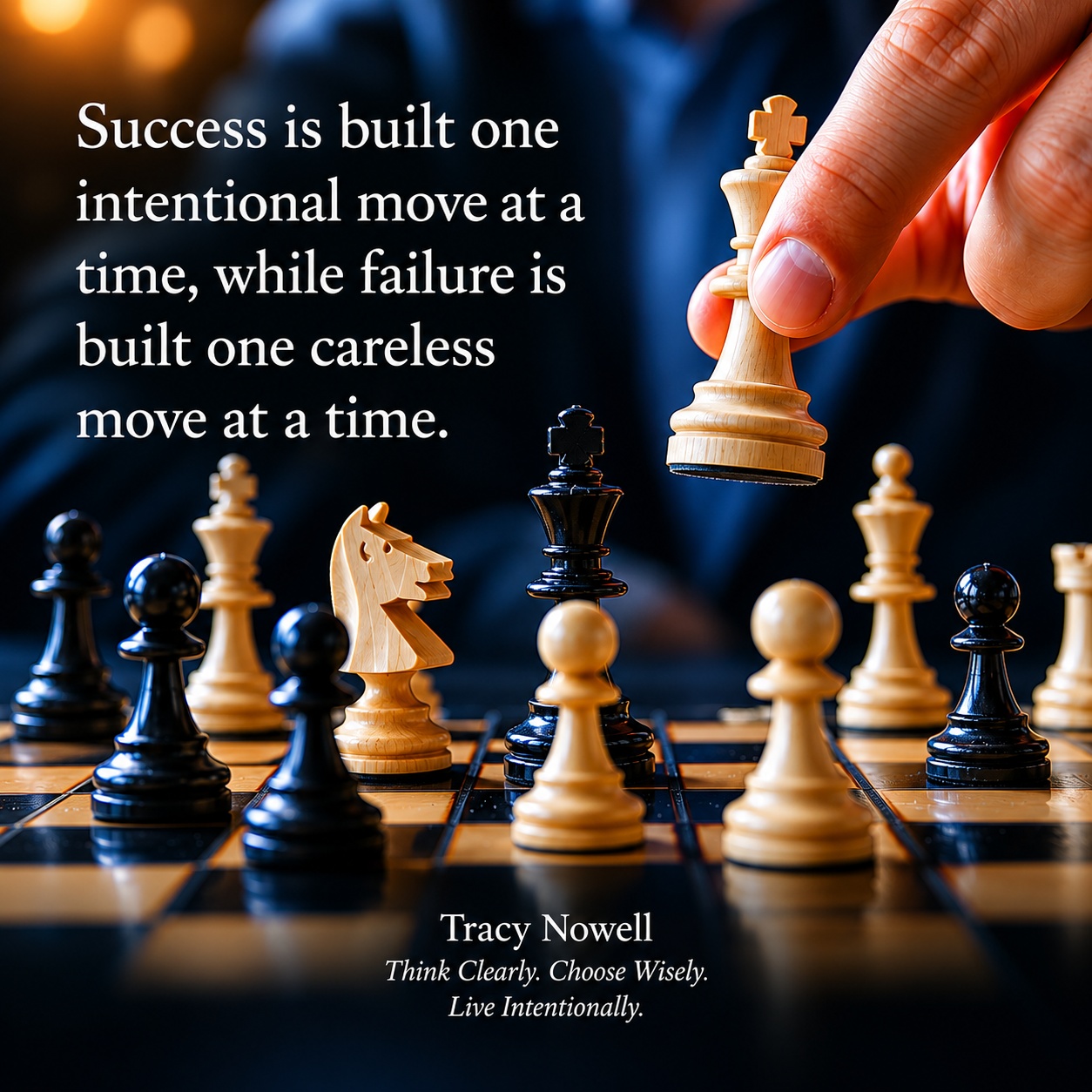
Which of these statements resonates more with your life experience?
- Success is built one intentional move at a time.
- Failure is built one careless move at a time.
The first statement was my attempt to capture the central idea behind this article, but I immediately realized it didn't tell the whole story, which led to the second.
Looking back, my life has been shaped by both success and failure. Careless moves taught me the importance of being more intentional. But I also learned that intentional actions don't guarantee success, just as careless actions don't always result in failure.
Think about a game of chess. We make a move, the other player makes a move, and each move forces us to reconsider our next move and its potential benefits and consequences. We don't control the other player's moves, but we are responsible for our own.
Life works much the same way - we make choices and take actions, but we don't control everything that affects our lives.
Circumstances change. Other people make choices that affect us. New opportunities emerge, problems occur, plans succeed or fail, and sometimes the unexpected changes the situation we face and the moves available to us.
Carelessness often shows up in -
- Our interpretation and understanding of what is happening within us, with others, and in our circumstances - relying on assumptions, incomplete information, or emotions that can distort our perception of the realities we face.
- What guides our choices - allowing circumstances, preferences, or competing pressures to take precedence over what we believe to be true, right, and most important.
- How we act - reacting impulsively, failing to follow through on what we know we should do, or failing to direct our time and energy toward what matters most.
One careless move may seem insignificant, but repeated carelessness can become a pattern with increasingly significant consequences.
Carelessness Can Look Like Foolishness
Nearly 3,000 years ago, King Solomon, known for the extraordinary wisdom God granted him, wrote extensively in the book of Proverbs about the differences between wisdom and foolishness.
I believe many of the characteristics Solomon associates with foolishness are also characteristic of careless living. Foolishness is not necessarily a lack of intelligence. But it often shows up in how a person thinks, chooses, and acts.
Throughout Proverbs, Solomon describes the fool as someone who -
- Acts recklessly or carelessly. (Proverbs 14:16 ESV)
- Thinks they know it all. (Proverbs 28:26 MSG)
- Speaks without considering the consequences. (Proverbs 18:6-7 NLT)
- Rejects instruction and correction. (Proverbs 15:5 AMP)
- Repeats the same foolishness. (Proverbs 26:11 NLT)
- Fails to control their emotions. (Proverbs 29:11 NKJV)
- Believes their own way is right without listening to advice. (Proverbs 12:15 ESV)
Solomon presents an equally clear picture of the alternative, describing the wise or prudent person as someone who -
- Gives careful thought to their steps. (Proverbs 14:15 NIV)
- Seeks and listens to wise counsel. (Proverbs 12:15; 19:20 NIV)
- Seeks knowledge. (Proverbs 18:15 NIV)
- Accepts instruction and correction. (Proverbs 9:8-9; 15:31-32 NLT)
- Learns and continues to grow in wisdom. (Proverbs 1:5 GW; 9:9 ESV)
- Exercises self-control over emotions. (Proverbs 14:29 GNT)
- Recognizes potential danger and takes appropriate action. (Proverbs 22:3; 27:12 NLT)
The distinction is not that the wise never make mistakes while fools always do. The difference is reflected in how we think, what guides our choices, how we act, and whether we are willing to learn and grow from our experiences.
In that sense, many of the characteristics Solomon associates with wisdom and foolishness are also reflected in the difference between intentional and careless living.
Some difficult situations result from our own carelessness; others involve circumstances we didn't create, expect, or choose. Either way, we still have to figure out what to do next.
Based on my experience, we can learn from our successes and even more from our failures. But learning from experience doesn't necessarily tell us what to do next.
Think Clearly. Choose Wisely. Live Intentionally.
So, how can we better understand ourselves and others, assess our circumstances, evaluate our alternatives and their potential consequences, and determine our next move?
I believe we need to focus on three fundamental areas.
1. Think Clearly — The quality of our discernment depends on the quality of our thinking. Clarity requires an accurate awareness of reality and a commitment to seeking truth.
Thinking clearly requires us to pay attention to what is really happening within us, around us, and in our circumstances. We need to remain curious, look beyond our initial assumptions, and avoid forming perceptions or drawing conclusions based on incomplete, misleading, or false information.
It requires us to pursue what is actually true rather than simply accepting what we believe, think, or feel. That means challenging our assumptions, examining our conclusions, and testing our understanding against reality.
Our experience can also inform our thinking, but only when we are willing to learn from it. What worked or didn't work? What did we misunderstand? What has changed? What do we know now that we didn't know before?
The closer our understanding aligns with reality, the better equipped we are to exercise sound judgment as we consider our alternatives before making our next move.
2. Choose Wisely — The quality of our choices depends on what guides them. Wise choices require a reliable anchor and a consistent alignment with the principles that flow from it.
Choosing wisely requires more than understanding the realities we face. We need a reliable basis for determining what to do - an anchor.
Our anchor is the truth we choose to trust and rely on to guide our lives. The values and guiding principles that flow from that anchor provide the standards we use to evaluate our decisions and direct our lives.
Guiding principles are more than principles we believe or sometimes embrace. They are principles we have intentionally chosen to consistently guide our choices, decisions, and actions, even when our preferences, emotions, circumstances, or competing pressures pull us in another direction.
Choosing wisely requires aligning our choices and decisions with those principles while considering what matters most, the alternatives available to us, and their potential benefits and consequences.
Experience can inform our judgment, but wisdom requires us to apply what we have learned to the realities we currently face. What was right before may not be right today, and knowing the difference can change what we choose to do.
3. Live Intentionally — The quality of our lives and the fruit of our efforts depend on the consistency with which we live out our guiding principles, the discipline with which we direct our time and energy, and the intentionality behind our actions.
Living intentionally begins with consistently applying our guiding principles across the different areas, roles, and responsibilities of life, even as those roles and responsibilities naturally change. In short, it's living with integrity.
It requires us to intentionally direct our time and energy toward what we have determined is most important. Without that focus, distractions, competing demands, convenience, and whatever most easily captures our attention can gradually pull us away from our priorities.
It also requires follow-through. Thinking clearly and choosing wisely accomplish little if we fail to act on what we have determined we should do.
The impact of how we live becomes evident in our relationships, our work, the way we serve and lead, and the contributions we make. Living intentionally helps us use our gifts, abilities, time, and effort in ways that yield meaningful, lasting benefits for ourselves and others.
Final Thoughts
As we move through life, we continually encounter new opportunities, challenges, successes, failures, and transitions. Those experiences often expose the adequacy - or inadequacy - of what has been guiding the way we think, choose, and live.
If we fail to honestly examine the inadequacies those experiences expose and make the necessary adjustments, we are more likely to drift into reactive living than intentionally direct our lives.
Growth is not linear. It is both incremental and iterative. Life's unpredictability and our own missteps require us to revisit and build on what we have learned.
Sometimes the lesson is triggered by a failure. Sometimes it is triggered by new opportunities, responsibilities, relationships, seasons of life, or challenges that require greater understanding and discernment. In either case, life often exposes what we have not yet learned, understood, or applied.
Returning to an earlier lesson does not necessarily mean we have failed. More often, it means life has revealed another opportunity to learn, grow, and mature.
We will never make every choice correctly or control everything life throws at us. But we can continue to learn, make adjustments when needed, and become better equipped to think clearly, choose wisely, and live intentionally.
“So be careful to live your life wisely, not foolishly.” - Ephesians 5:15 (CEB)